Close your eyes and touch your nose.
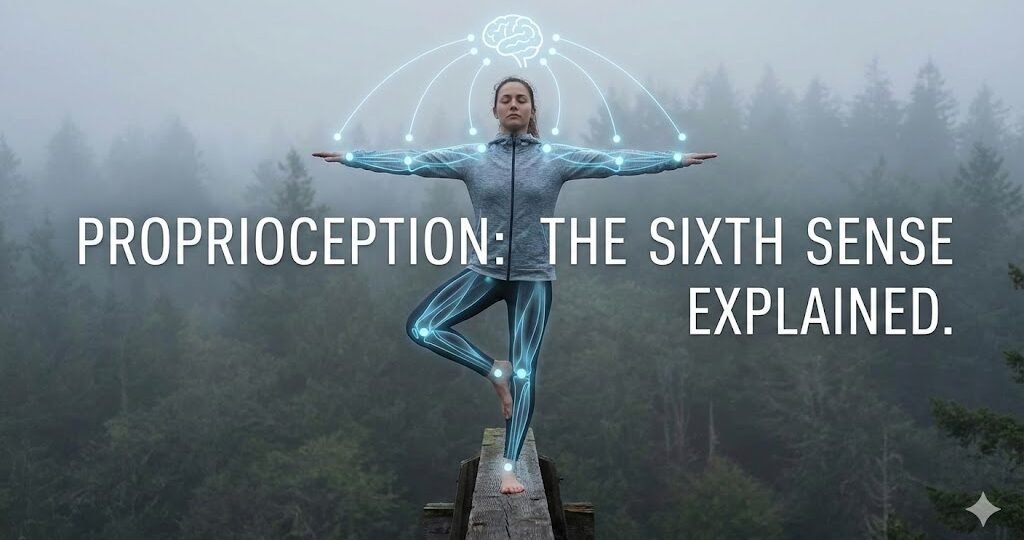
You didn’t need to see your hand to do that. You didn’t calculate angles. You didn’t consciously measure distance. Yet your finger arrived, confidently, at its target. That silent guidance system is called proprioception—your sense of body position.
Most people learn about five senses in school. Vision, hearing, smell, taste, touch. Clean. Simple. Incomplete. Proprioception is one of several “hidden senses” your nervous system runs automatically. Tiny receptors in your muscles and joints—called muscle spindles and Golgi tendon organs—constantly report stretch, tension, and movement to your brain. Without them, you wouldn’t just feel clumsy. You wouldn’t be able to move smoothly at all.
There are rare neurological cases where proprioception fails. Patients can move—but only if they watch their limbs. The moment they close their eyes, coordination collapses. Walking becomes a conscious puzzle. The automatic becomes exhausting. It reveals something strange: most of what you experience as effortless control is actually outsourced to subconscious neural machinery.
From a philosophical angle, this is deliciously unsettling. Your sense of “self” feels like it lives behind your eyes. But your identity is anchored in feedback loops between muscles, spine, cerebellum, and cortex. Even your posture influences mood. Stand upright and neural patterns shift. Slouch long enough and they shift differently. The body informs the mind as much as the mind directs the body.
Proprioception is the quiet cartographer of your existence. It draws the map of “you” in space. Without it, the boundary between self and world blurs. With it, you move through reality with unconscious precision. And like many of the nervous system’s miracles, you only notice it when it falters—which is the brain’s way of reminding us that the most important systems are often invisible.
RELATED POSTS
View all