Concrete is one of the most widely used engineering materials in the world, but it has an unavoidable weakness: it cracks. Small cracks may appear because of temperature changes, drying, repeated loads, or the natural movement of a structure. They may seem harmless at first, but water can enter through them, eventually reaching the steel reinforcement inside and causing corrosion. Engineers have therefore been exploring a strange idea: what if concrete could repair its own cracks?
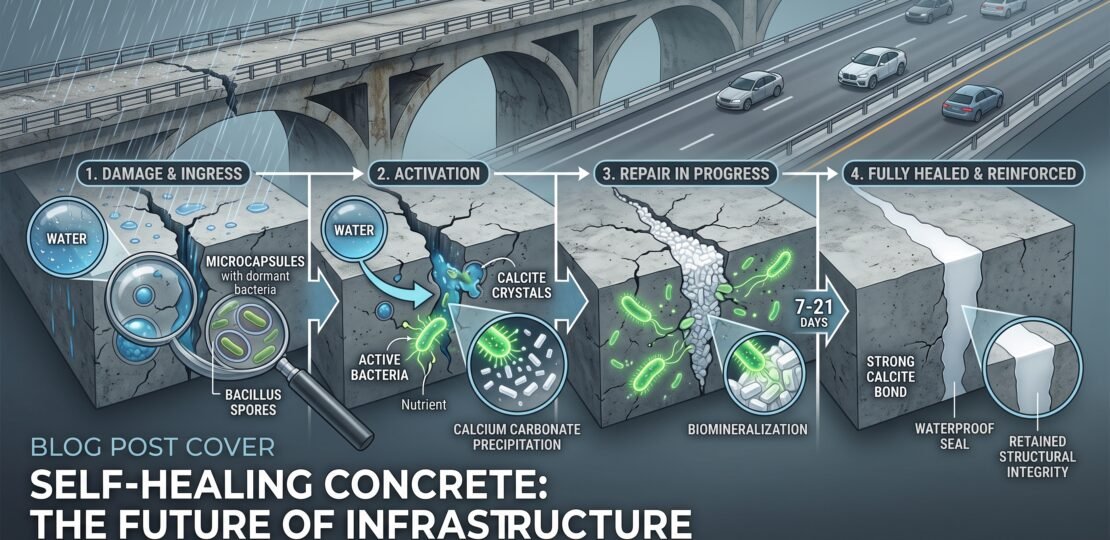
One approach uses bacteria embedded inside the concrete. Certain bacteria can remain dormant inside tiny protective capsules for years. When a crack forms and water enters, the bacteria become active. They consume nutrients placed inside the concrete and produce calcium carbonate, essentially limestone, which gradually fills the crack. The material is not being repaired by a worker after the damage occurs; the structure contains the ingredients necessary to repair itself.
The engineering challenge is keeping the bacteria alive during the manufacturing and lifetime of the concrete. They must survive the highly alkaline environment inside concrete, remain dormant until needed, and become active when water reaches them. Engineers also have to ensure that the process does not significantly weaken the concrete in its undamaged state.
Other self-healing approaches do not use bacteria. Some experimental materials contain microcapsules filled with healing agents. When a crack reaches one of these capsules, it breaks open and releases material that flows into the damaged region and hardens. Another approach uses concrete formulations that can continue chemical reactions long after the material has been poured, allowing certain small cracks to gradually close.
The potential advantage is enormous because concrete structures are expected to last for decades. Bridges, tunnels, dams, and buildings can be difficult and expensive to inspect and repair, particularly when damage occurs in inaccessible areas. A material capable of automatically sealing small cracks could extend the useful life of these structures and reduce the amount of maintenance required.
The idea represents a subtle shift in engineering philosophy. Traditional materials are designed to resist damage for as long as possible. Self-healing materials add another capability: responding to damage after it happens. Instead of treating failure as the end of a material’s useful life, engineers are beginning to imagine structures that can detect their own damage and initiate the first stage of their own repair.
RELATED POSTS
View all


The Parker Solar Probe – Humanity’s Closest Encounter with the Sun
February 28, 2025 | by Venkat Balaji