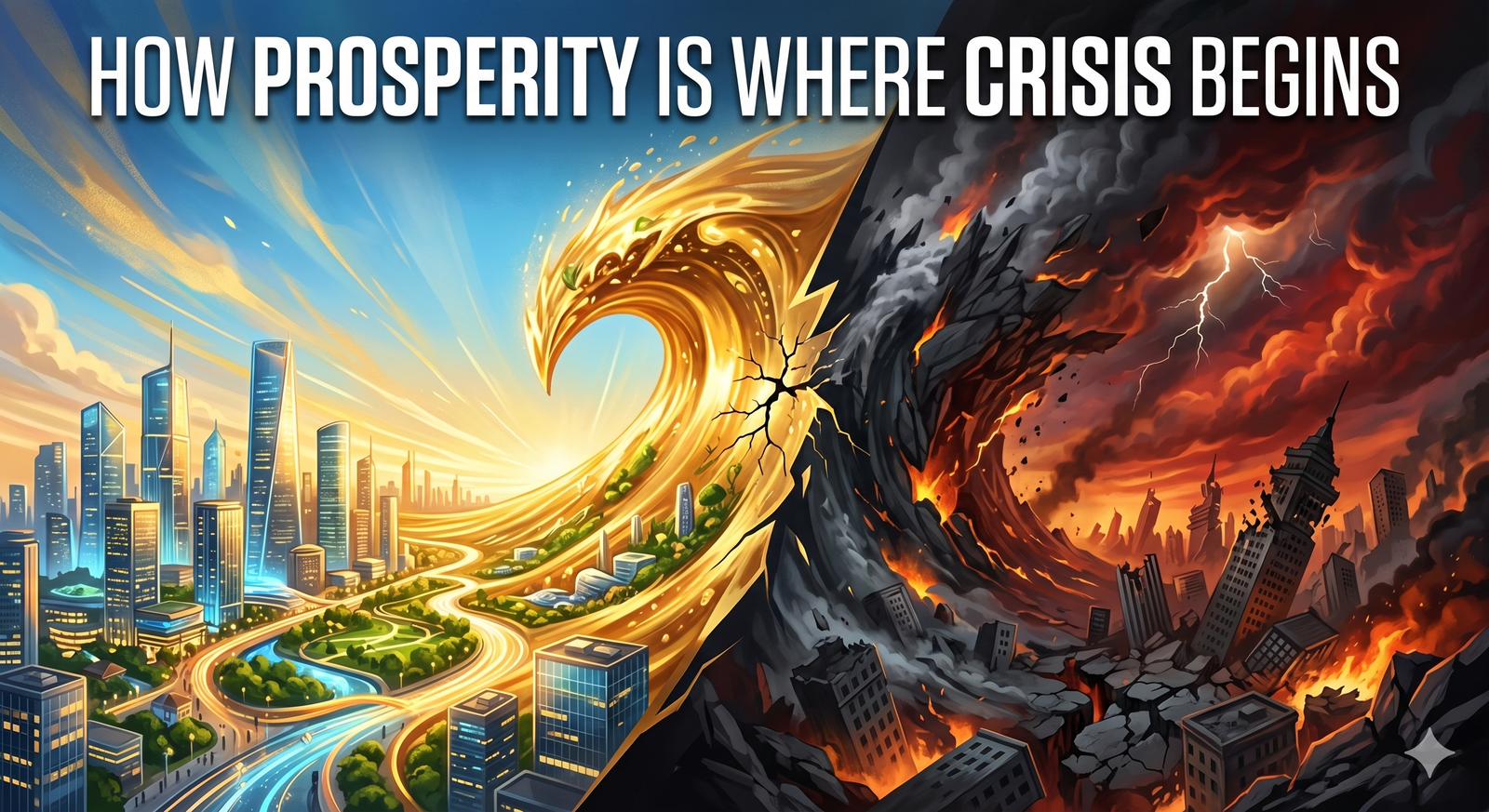
One of the strangest patterns in economic history is not collapse or growth—but forgetfulness. Societies rarely fail because they lack knowledge. They fail because knowledge fades in relevance when conditions improve. Once stability returns, the memory of past constraints weakens, and with it, the discipline that those constraints created.
In moments of crisis, economies become brutally efficient in one sense: they remember limits. Resources are scarce, risks are visible, and decisions are forced to be deliberate. But as recovery begins, that clarity dissolves. The urgency that once shaped behavior gets replaced by confidence. Institutions that were tightened under pressure are relaxed. Safeguards that were essential in hardship begin to feel excessive in prosperity.
This shift is not irrational—it is almost adaptive. Human systems are designed to normalize conditions. What was once unthinkable becomes routine again. Credit expands because defaults seem unlikely. Oversight weakens because abuses appear rare. Risk is redefined not by probability, but by recent experience. And slowly, the system rebuilds the very conditions it once struggled to escape.
What makes this cycle persistent is that each generation inherits a softened version of memory. The people who experienced the last crisis carry its lessons strongly, but over time they are replaced by those who only experience its aftermath. For them, the rules feel restrictive without the emotional weight that justified them. So the system shifts again—quietly, incrementally—until it approaches familiar vulnerabilities.
This phenomenon is visible across financial cycles, policy shifts, and even technological optimism. Innovations that once required caution become overtrusted. Tools designed as solutions gradually become assumptions. And assumptions are where fragility hides best.
The deeper pattern suggests that economies don’t just move through cycles of growth and contraction—they move through cycles of memory and forgetting. Each phase of stability is also a phase of erosion in institutional memory. And each crisis is, in part, a forced recall of lessons that were never fully erased, only ignored.
Seen this way, economic history is less about discovering new principles and more about repeatedly relearning old ones under different conditions. The cost of forgetting is not immediate—it is deferred. And when it arrives, it always feels sudden, even though it was quietly built over time.
RELATED POSTS
View all