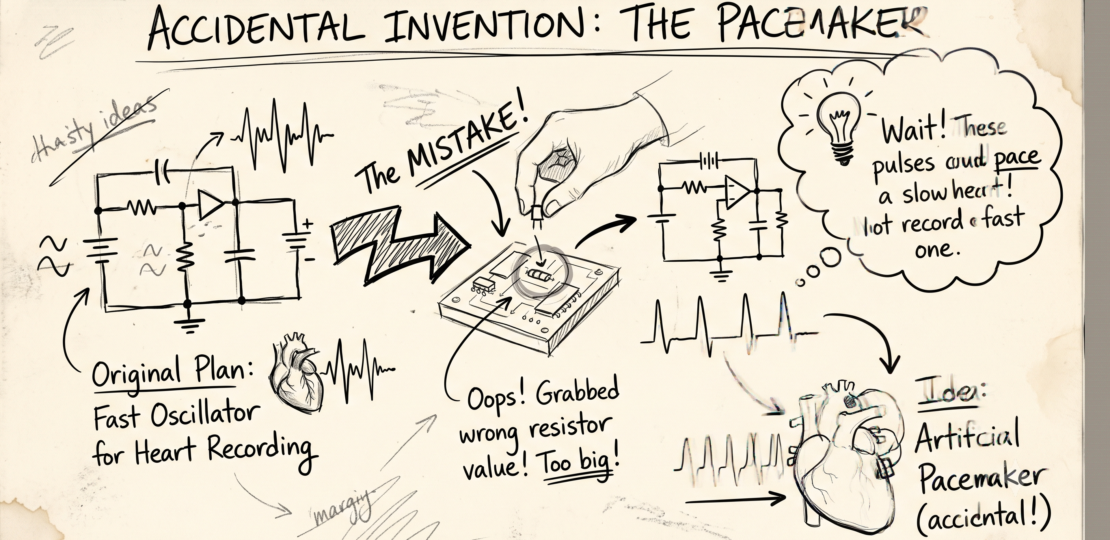
In 1956, engineer Wilson Greatbatch was trying to build a device that could record the electrical signals produced by a heart. He was working with a small electronic circuit designed to measure those signals when he reached for a component. He accidentally grabbed the wrong resistor.
The mistake should have ruined the experiment.
Instead, the circuit began producing electrical pulses at a regular rhythm—roughly the same rhythm as a human heartbeat. Greatbatch stared at the device. It wasn’t recording the heart anymore. It was imitating one.
That accidental observation gave him an idea. If an artificial electrical pulse could reproduce the timing of a heartbeat, perhaps such a device could be implanted inside a person whose heart was beating too slowly. At the time, patients with severe heart rhythm problems had very limited options. External electrical stimulators existed, but they were large, unreliable, and connected to patients by wires.
Greatbatch spent the next two years shrinking his invention and adapting it for implantation. In 1958, a version of his device was implanted into a patient in Sweden. The first implant lasted only a few hours before the battery failed, but the principle worked. Later versions became smaller and more reliable, eventually leading to the modern implantable pacemaker.
The transformation was extraordinary. A component picked up by mistake had revealed a completely different use for the circuit Greatbatch was building. What began as an error in an electronics experiment eventually became a technology capable of regulating the heartbeat of millions of people.
The fascinating part isn’t really the mistake. Wrong components are picked up in laboratories all the time. What mattered was that Greatbatch noticed the unexpected behavior instead of immediately correcting it. The accident created the possibility; curiosity turned it into an invention.
Sometimes progress begins not when an experiment works exactly as planned, but when something goes wrong in an interesting way.
RELATED POSTS
View all