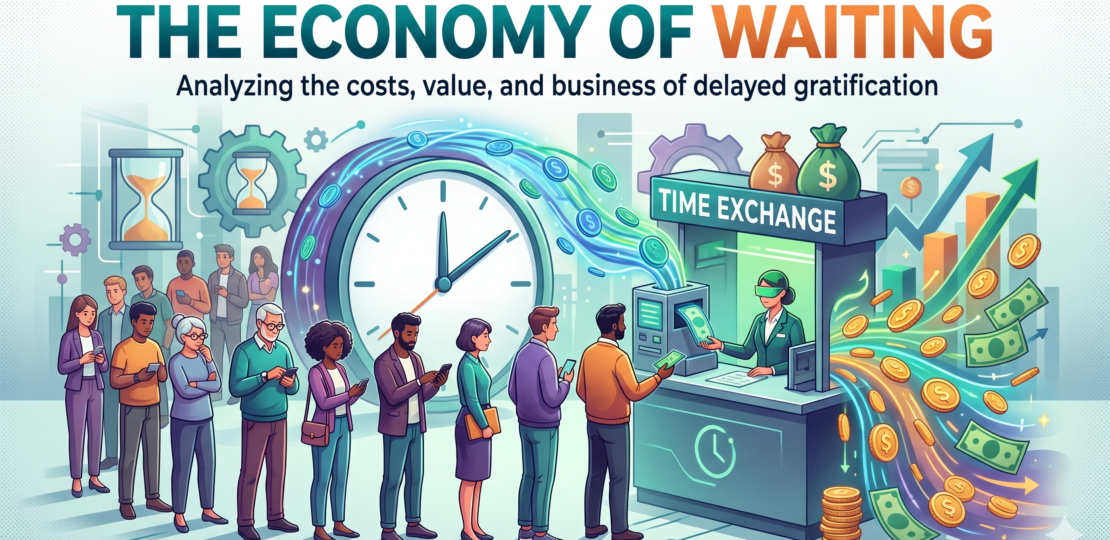
We usually think of economics in terms of money—income, prices, wealth. But across history, there’s another resource that quietly shapes entire systems: time. Not just how much people have, but how long they are forced to wait. In many periods, especially under strained or unequal systems, access to goods and opportunities isn’t determined by price alone—it’s determined by patience.
This shows up most clearly when supply is constrained or institutions are inefficient. Instead of raising prices, systems often shift the burden elsewhere: queues. Long lines for basic goods, months-long waits for permits, years spent hoping for access to education or employment. In these environments, time becomes a hidden currency. Those who can afford to “spend” time—by waiting, navigating bureaucracy, or enduring uncertainty—gain access. Those who cannot are excluded, even if they have the money.
Historically, this phenomenon has appeared in very different forms. In tightly controlled economies, queues replaced markets. In rapidly growing ones, bureaucratic delays ration opportunity. Even in modern systems, the pattern persists in subtler ways—long hiring processes, delayed healthcare access, or competitive systems where thousands compete for a handful of positions. The structure changes, but the principle remains: scarcity expresses itself through time.
What makes this dynamic interesting is how it reshapes inequality. Traditional economics focuses on wealth gaps, but time inequality is just as real. A person working multiple jobs cannot afford to wait in lines or navigate slow systems. Someone with more flexibility can. Over time, this creates a feedback loop—those with time gain more opportunities, and those without fall further behind, not because of lack of ability, but because of constrained bandwidth.
There’s also a psychological layer to it. Waiting changes behavior. It creates fatigue, reduces decision quality, and shifts priorities toward short-term survival rather than long-term growth. Entire populations can become shaped by systems that make them wait—not just economically, but mentally. The cost isn’t visible in GDP, but it accumulates in lost potential.
This recurring pattern suggests something subtle about how economies operate under pressure. When price cannot do the job of allocation—whether due to policy, culture, or constraint—time steps in. And unlike money, time is distributed far less equally than we assume. Some people live in fast lanes; others are stuck in queues. Over long stretches of history, that difference quietly defines who moves forward and who doesn’t.
RELATED POSTS
View all