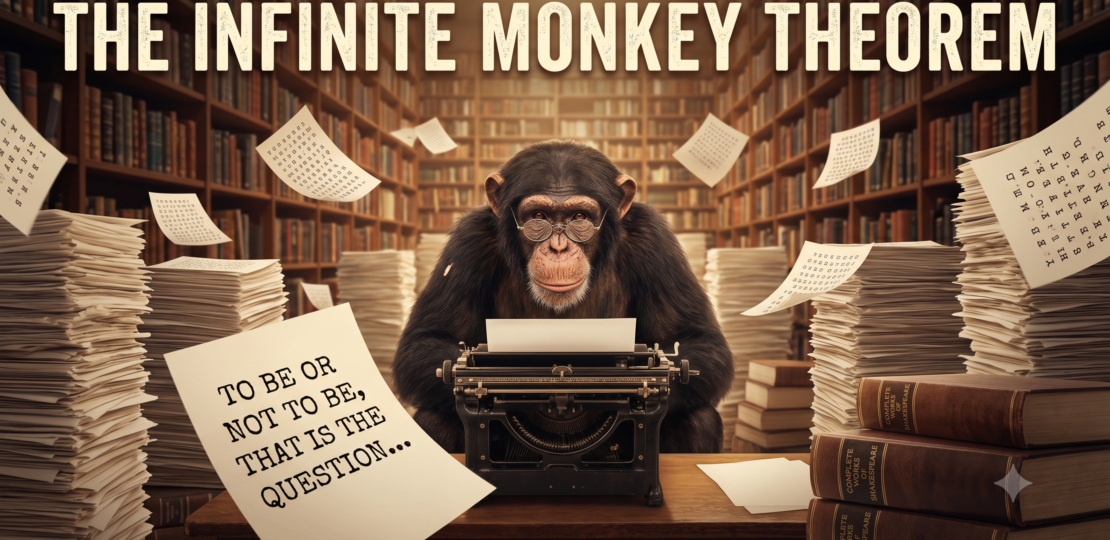
If a monkey were placed in front of a typewriter and given an infinite amount of time, it would eventually produce Hamlet.
At first glance, the statement sounds ridiculous. Anyone who has watched random letters appear on a keyboard knows that meaningful words are rare, coherent sentences rarer still, and a complete Shakespearean play essentially unimaginable. Yet mathematics suggests that given unlimited opportunities, the impossible-looking becomes inevitable.
This idea is known as the Infinite Monkey Theorem. The reasoning is surprisingly simple. Every time the monkey strikes a key, there is some tiny chance that it presses the correct letter. The chance of producing an entire line from Hamlet is astronomically small. The chance of producing the entire play is smaller still. But crucially, the probability is not zero. If the monkey continues typing forever, eventually every possible sequence of letters will appear somewhere in its output.
The theorem is less interesting because of what it says about monkeys and more interesting because of what it says about probability. In everyday life, people often treat “extremely unlikely” and “impossible” as the same thing. The difference rarely matters because our lives are finite. A monkey will never type Hamlet in a classroom experiment. It probably will not type Hamlet during the lifetime of humanity. Yet probability theory insists that unlikely events and impossible events belong to entirely different categories.
What makes the thought experiment memorable is that it reveals how poorly intuition handles infinity. Human beings are comfortable thinking about thousands or millions of attempts. Infinity is different. When the number of opportunities becomes limitless, even outcomes with vanishingly small probabilities eventually occur. The conclusion feels wrong not because the mathematics is flawed, but because infinity lies far outside ordinary experience.
There is also something reassuring about the theorem. If an infinite collection of monkeys eventually reproduces Shakespeare’s works, it does not make Shakespeare any less remarkable. Randomness may generate the same sequence of letters, but it cannot explain the insight, imagination, and intention that produced them in the first place. The theorem concerns what can happen by chance, not how meaning is created.
In the end, the Infinite Monkey Theorem is a reminder that probability often defies common sense. A monkey typing Hamlet sounds impossible until mathematics draws a distinction between impossible and merely improbable. The monkeys themselves are almost beside the point. The real subject of the theorem is infinity—and the strange conclusions that emerge when chance is given unlimited opportunities.
RELATED POSTS
View all