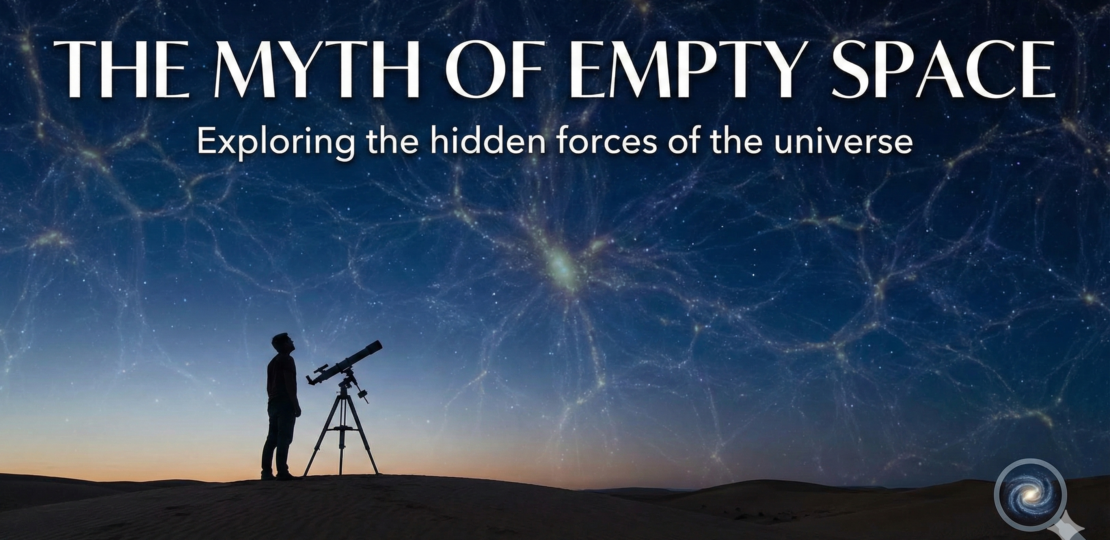
“Nothing” sounds simple. No matter, no light, no activity. Physics ruined that idea decisively. What we casually call empty space—the vacuum—is one of the most restless things in the universe.
In quantum physics, fields exist everywhere. Particles are not little beads floating in space; they’re ripples in these fields. Even when no particles are present, the fields themselves can’t fully settle down. Thanks to the uncertainty principle, their energy can’t be exactly zero. The result is a vacuum that constantly jitters.
This jitter shows up as vacuum fluctuations. Pairs of particles and antiparticles briefly appear and annihilate each other. They aren’t popping in and out of existence in a naive sense—that’s a loose metaphor—but the measurable effects are real. Two uncharged metal plates placed extremely close together will feel an attractive force. This is the Casimir effect, caused not by matter, but by the structure of empty space itself.
The consequences go far beyond lab experiments. Vacuum energy influences how the universe expands. On cosmic scales, this restless background may be linked to dark energy, the mysterious pressure pushing galaxies apart faster and faster. The emptiest regions of space might be doing the most work.
So “nothing” turns out to be a misnomer. Empty space has rules, energy, and consequences. It shapes reality quietly, without ever showing up as a thing you can point to. The universe is not built on a foundation of nothingness, but on a kind of invisible tension—space itself, forever refusing to sit still.
RELATED POSTS
View all