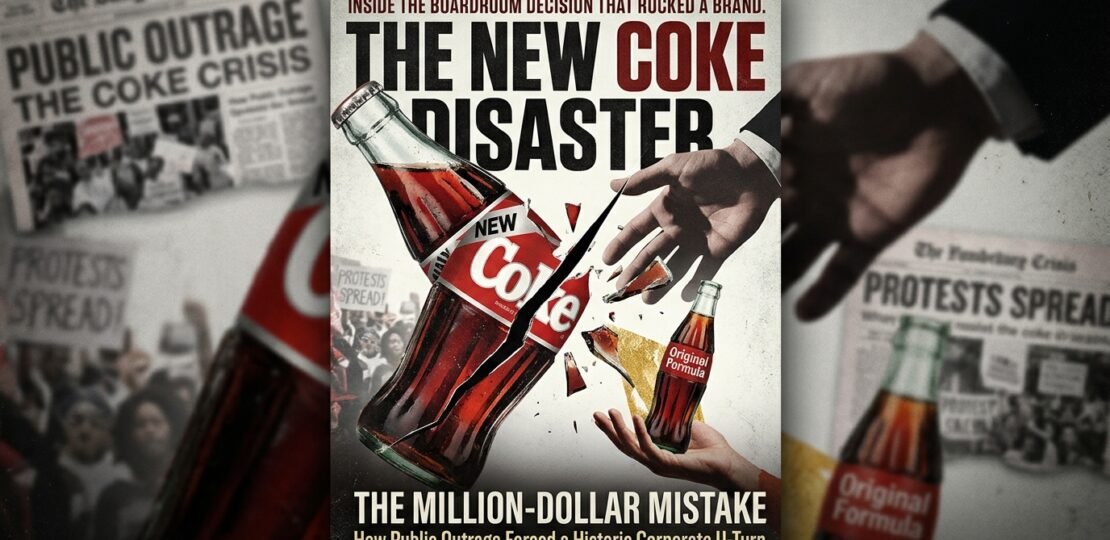
In April 1985, Coca-Cola made a decision that seemed perfectly reasonable on paper. Its rival, Pepsi, was gaining ground, and taste tests suggested that consumers preferred a sweeter cola to the drink Coca-Cola had sold for nearly a century. The company had the research, the resources, and the confidence to act. On April 23, it announced that the original Coca-Cola formula would be replaced by a new one. The product was called New Coke. What followed became one of the most famous corporate miscalculations in history.
The decision was not born out of ignorance or carelessness. Coca-Cola had spent years testing its new formula, conducting extensive taste tests across the United States and Canada. The results appeared convincing: consumers often preferred the sweeter drink, even when compared with the original Coca-Cola. Yet the company had asked a narrow question and mistaken the answer for a complete understanding of its customers. It had tested which drink people preferred in a tasting, but had not adequately considered how they would react to losing the drink they already loved.
The backlash was swift. Customers complained by telephone and letter, and some organized protests. To Coca-Cola, the change had been an attempt to improve its product and compete more effectively. To many of its customers, it felt as though the company had taken something familiar away without asking permission. After just 79 days, Coca-Cola announced that the original formula would return as Coca-Cola Classic. A decision intended to strengthen the company’s position had forced it to reverse one of its most publicized changes.
The mistake was not that Coca-Cola used data. It was that the company treated one kind of data as though it answered every relevant question. Taste tests measured preferences under particular conditions; they could not fully capture habit, nostalgia, brand identity, or the frustration of having a choice taken away. Coca-Cola understood the composition of its drink better than almost anyone, but it had underestimated the meaning consumers attached to it. The product was not merely a combination of ingredients. It was also a familiar part of people’s lives, and changing the formula changed more than its flavor.
There is a lesson here for every organization that creates a product, provides a service, or makes decisions on behalf of others. Understanding a problem is not the same as measuring one aspect of it. A company can collect thousands of responses and still ask the wrong question. An engineer can optimize a component while overlooking the needs of the person who will use it. A university can redesign a course around examination results while ignoring whether students can apply what they have learned. Data is valuable, but only when the questions behind it are sufficiently broad to capture the reality being examined.
Coca-Cola’s experience also illustrates the danger of confusing improvement with replacement. Organizations often become so focused on correcting weaknesses that they overlook the qualities people already value. A familiar process may appear inefficient to management but remain effective for reasons that are not immediately visible. A product may have imperfections that customers tolerate because its other qualities matter more to them. This does not mean established systems should never change. It means that before replacing something successful, an organization must understand not only what could be improved, but also what must be preserved.
Ultimately, Coca-Cola did not need to abandon innovation; it needed to understand its own success more completely. The company had correctly identified a competitive threat but had misjudged what its customers were defending. The original formula returned, and the episode became a lasting lesson in consumer loyalty and corporate humility. The next time an organization considers replacing a familiar product or overhauling a successful process, it should ask a question more important than whether the alternative performs better in a controlled test: Do we understand what makes the original worth keeping?
RELATED POSTS
View all