The Observer Effect: The Curious Comfort of Being Watched
January 16, 2026 | by Venkat Balaji
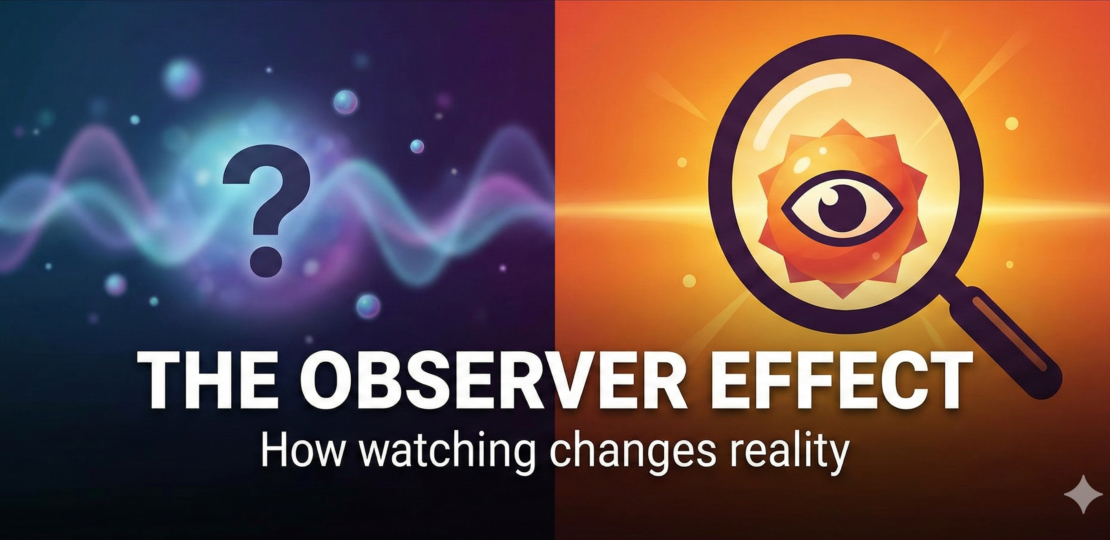
Behavioral psychology has a habit of revealing how easily the mind can be nudged by invisible hands. One of the oddest nudges is the observer effect in everyday behavior: people act differently when they believe they are being watched, even if the “watcher” is imaginary or symbolic. Put a picture of eyes near an honesty box in a café, and donations quietly rise. No lecture, no enforcement, just a pair of printed pupils doing the work of social pressure. The mind, it seems, evolved in a village where someone was always looking.
This works because humans are exquisitely sensitive to reputation. Long before résumés and social media, survival depended on how others judged you. Behavioral psychologists describe this as internalized social monitoring. Over time, the external gaze became an internal one. That inner narrator—half conscience, half audience—keeps score even when the room is empty. The result is a curious loop: we behave well not because someone is watching, but because someone could be watching.
What makes this fascinating is how little information the brain needs to activate the loop. Studies show that abstract cues—stylized eyes, mirrors, even reminders of norms—can shift behavior. The brain does not pause to verify whether the watcher is real. It treats the cue as probabilistic evidence and adjusts behavior just in case. From an evolutionary perspective, this is efficient. The cost of being slightly more honest when alone is small. The cost of being caught violating norms is enormous.
There’s a quieter implication here. Much of what we call “self-discipline” may actually be borrowed discipline, inherited from a social world that trained us to regulate ourselves. Productivity apps with streaks, public goals, and accountability partners all tap into the same ancient circuitry. Behavioral psychology doesn’t tell us that humans are irrational; it tells us we are deeply social animals pretending to be independent minds. The watcher never fully leaves the room—it just learns how to live inside us.
RELATED POSTS
View all