Welcome back. This is chapter 18 of The Psychology of Money. This is the last individual chapter; the next two are summaries and Housel’s personal investment ideologies. This chapter is one of the finest human analyses I’ve read. It seems obvious in hindsight, but severely neglected in real life.
Chapter 18: When You’ll Believe Anything
Economies don’t collapse first on balance sheets. They collapse in stories. The numbers usually follow later, like a shadow arriving after the body has already passed. In that sense, stories are rarely the original sin—but they are powerful accelerants. Sometimes they merely pour fuel on an existing fire. Occasionally, they strike the match themselves. Context decides which.
Appealing fictions thrive because they offer something deeply human: relief. Not truth, not accuracy—relief. They substitute false hope for real uncertainty, and that substitution is voluntary. No one forces belief. The danger lies precisely there. When hope is detached from reality yet feels emotionally convincing, it becomes self-deception. Real hope demands confrontation with constraints; appealing fictions dissolve constraints with narrative glue and call it optimism.
Statistics, for all their rigor, are emotionally mute. They register movements, not meanings. A graph can show a market falling, but it cannot show the knot in a parent’s stomach wondering how long savings will last. Surveys attempt to bridge this gap, but even those are imperfect mirrors. People lie—not always maliciously, often subconsciously. Numbers struggle to capture fear, pride, denial, or desperation. Stories step into that vacuum. They explain what numbers merely describe.
False optimism is more dangerous than pessimism because it lulls rather than alarms. Yet it’s rarer than we think. As we learned in the last chapter, humans are not naturally optimistic creatures; we are threat-detecting organisms shaped by millennia of risk. When false positives do take hold—when people believe things are safer than they are—the damage tends to be severe precisely because defenses are lowered.
At the same time, our tendency to credit skill and downplay luck sits at an uncomfortable intersection: it is both an intellectual error and a psychological necessity. Without believing our actions matter, work feels hollow. Effort needs a narrative payoff. Meaning requires causality, even if that causality is exaggerated. The world runs partly on this illusion, which makes it hard to discard without losing motivation itself.
Appealing fictions, then, are not something you can eliminate entirely. They resemble modern distractions: avoidable in theory, unavoidable in practice. You can reduce exposure, not achieve purity. The goal isn’t to live story-free, but to remain aware that stories are tools—not truths. Acting reasonably matters more than acting perfectly rationally.
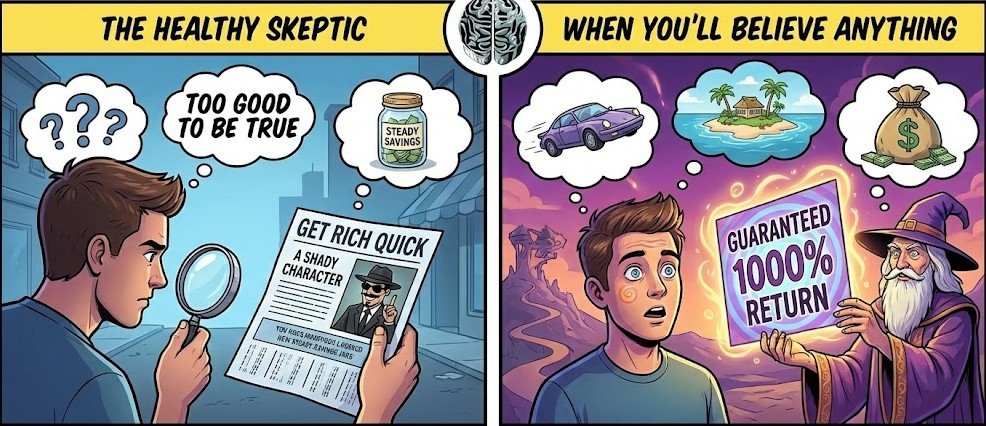
The best defense isn’t cynicism; it’s probabilistic thinking paired with clarity of thought. Understanding that outcomes live on distributions, not certainties. Reading history not as prophecy but as a catalogue of human behavior repeating under new costumes. Books like The Psychology of Money don’t immunize you against false belief—but they slow you down just enough to ask: What must be true for this story to work? And how wide is the gap between what I want to believe and what reality requires?
When that gap grows too large, belief turns from hope into hazard. And that’s usually the moment when people, quite sincerely, will believe almost anything.
Now, an additional note. Appealing fictions can also become impossible to ignore in moments of desperation. History offers grim medical examples—burning, bleeding, and other brutal practices once believed to “drain” sickness—born from a lack of scientific understanding and an urgent need for relief. These are difficult times, but again, try your best to think clearly and reasonably; there is a more likely than not always a better option.
RELATED POSTS
View all