Welcome back. This is chapter 8 of the Psychology of Money.This is the shortest chapter, lasting only 2 pages, so I had a tough time writing this. Therefore, I decided this would be a deeper exploration of my opinions, expanding outward with its ideas further than other chapters. Let’s get on with it.
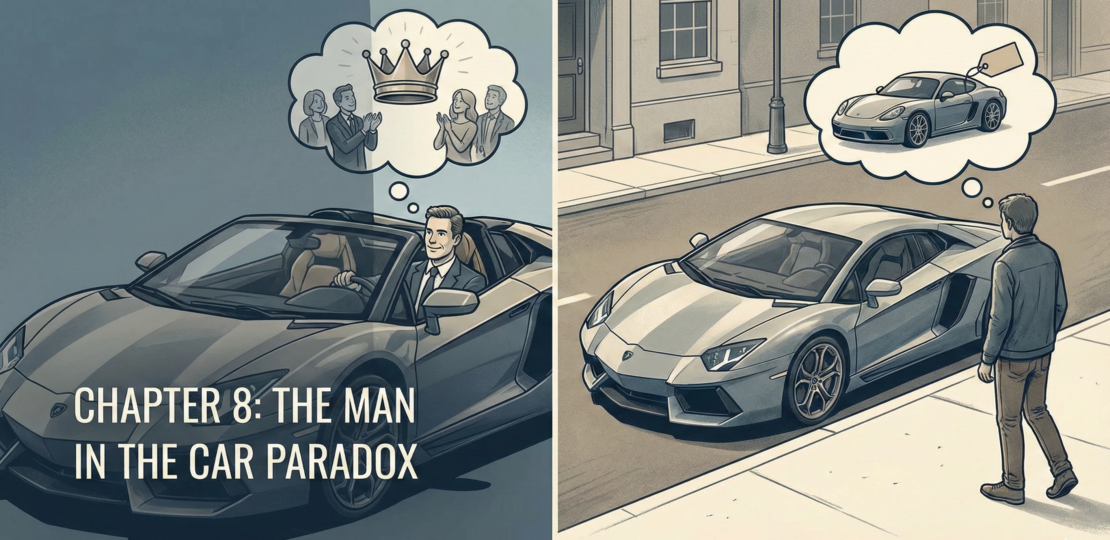
Chapter 8: The Man in the Car Paradox
This chapter feels obvious the moment it’s explained—and that’s precisely why it works. You see the car. You rarely see the driver. And yet, so much of modern effort is spent polishing the vehicle, convinced it will somehow transfer admiration to the person inside. The paradox isn’t that this fails. The paradox is how long we continue believing it will work.
The desire behind material pursuit isn’t really about objects. It’s about respect and admiration. But people who haven’t experienced genuine respect often confuse the two. They assume admiration can be purchased, that status symbols are shortcuts to meaning. That belief isn’t infuriating—it’s pitiable. Because once you’ve felt respect that comes from character, competence, or contribution, material validation feels thin, almost embarrassing.
Respect and fame live in different oceans, though they occasionally intersect. You can be deeply respected within a small circle and completely unknown to the world. You can also be widely famous and privately hollow. Wanting one can sometimes mean wanting the other, but not always—and confusing them leads to chasing applause when what you really wanted was acknowledgement.
Possessions, for the most part, don’t signal character. They signal taste, desire, and power. Very rarely do they hint at inner substance. A library built with care might say something. Most other things don’t. We project meaning onto objects because it’s easier than building meaning within ourselves.
The respect that actually matters comes from a narrow group: parents, close family, trusted friends, and those you genuinely look up to. When someone you admire respects you in return, that moment carries a weight no external display can replicate. That kind of validation can’t be hacked. It has to be earned slowly, and often quietly.
Humility complicates things. It can be worn as a mask, yes—but real wealth shows up when humility stops being optional. When it becomes an irreplaceable organ rather than a performance. Respect that lasts is built through consistent exhibitions of character: how you work, how you think, how you treat people, how you hold your values under pressure. Lose those, and nothing compensates.
Whether the man-in-the-car paradox is something to escape or simply to remain aware of is still unclear. Perhaps the point isn’t purity. Perhaps it’s doubt. To pause before assuming admiration lives where money points. To remember that most people aren’t looking at you—they’re looking past you, toward their own reflections.
It’s okay to not know everything; after all, there is no point in reading a story after you find out the end, right?
RELATED POSTS
View all