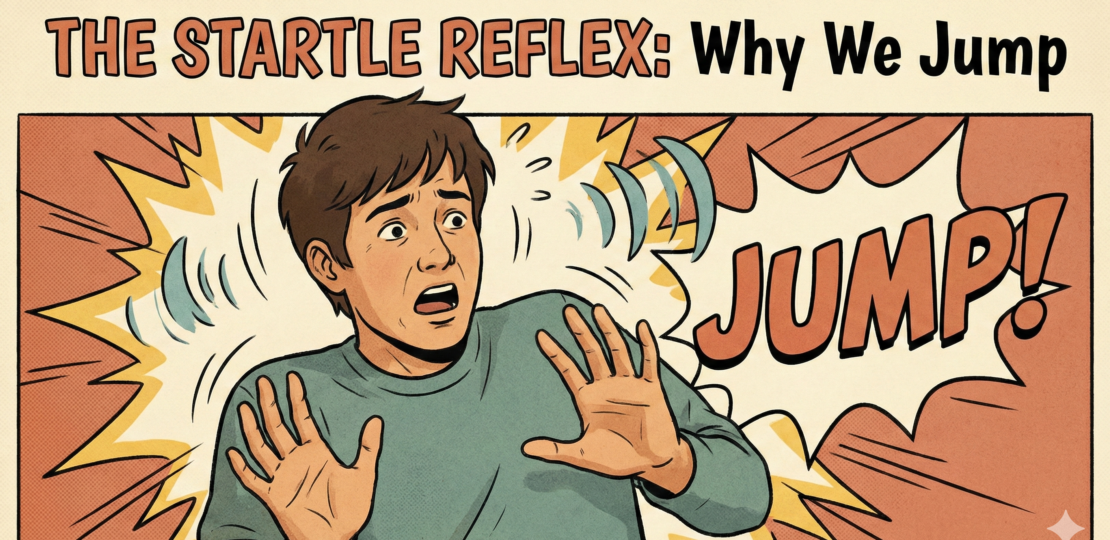
A loud bang goes off. Before you think, your shoulders jerk, your eyes blink, your heart jumps.
That split-second reaction is the startle reflex—one of the fastest defensive responses in your nervous system. The signal travels from your ears to the brainstem and back to your muscles in milliseconds. No committee meeting in the cortex. No philosophical reflection. Just action.
The core circuitry runs through the lower brainstem, particularly areas like the pontine reticular formation. The amygdala—deep in the temporal lobe—can amplify this reflex if the stimulus carries emotional significance. If you’re already anxious, the startle response becomes stronger. If you feel safe, it softens. The reflex isn’t fixed; it’s modulated by context.
This reflex is ancient. Fish have versions of it. It evolved because hesitation could mean death. Better to overreact to a snapping twig than to underreact to a predator. Evolution prefers false alarms over missed
threats.
Here’s where it gets psychologically interesting. Researchers use the strength of the startle reflex as a window into emotional states. In anxiety disorders, the reflex can be heightened even in neutral environments. The nervous system becomes biased toward threat detection. The alarm system is tuned too high.
There’s a lesson hiding here. Your body often reacts before your narrative catches up. That surge of adrenaline in an exam hall. That jump when your phone buzzes unexpectedly. The nervous system moves first; interpretation follows.
You are not always the author of your first reaction. You are, however, the editor of what happens next. The startle reflex reminds us that beneath conscious thought lives an older guardian—quick, imperfect, and fiercely protective.
RELATED POSTS
View all