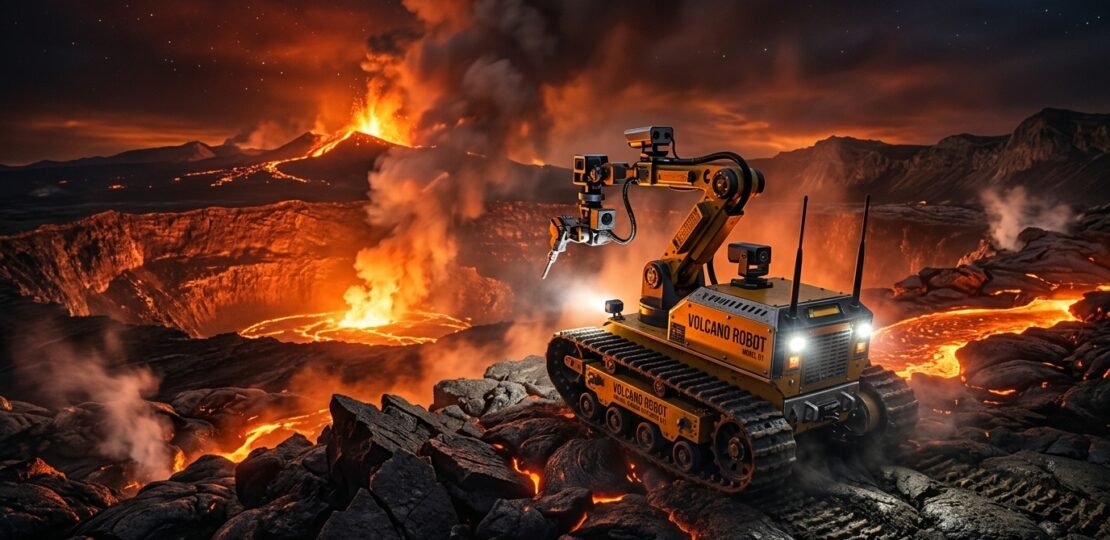
Volcanoes are among the most hostile environments on Earth. Temperatures can reach hundreds of degrees Celsius, gases can be corrosive and toxic, and terrain can shift without warning. Yet understanding what happens inside an active volcano is extremely valuable. The difficulty is that sending a person into such an environment is dangerous, while conventional robots can quickly be destroyed by the heat.
Engineers have therefore explored robots specifically designed to operate in volcanic environments. One approach is to build machines with heat-resistant materials and protect their electronics from the surrounding environment. The challenge is not simply finding a material that can survive high temperatures. Motors, batteries, sensors, wiring, and computers each have their own temperature limits, meaning that a robot may encounter conditions that its mechanical structure can tolerate but its electronics cannot.
One experimental solution has been to separate the robot’s sensitive components from the hottest environment. Instead of placing all of the electronics directly inside the machine, engineers can use insulation, thermal barriers, and specialized cooling systems to slow the transfer of heat. The robot may therefore spend only a limited amount of time in the hottest regions before retreating to a cooler area.
Mobility presents another problem. Volcanic terrain is nothing like a laboratory floor. Loose rocks, steep slopes, ash, cracks, and irregular surfaces can make ordinary wheels unreliable. A robot must maintain traction while climbing and avoid becoming trapped in unstable material. Its movements also have to be carefully controlled because a fall could destroy the machine even if its electronics remain within their temperature limits.
The reason for building such machines goes beyond simply proving that a robot can survive. Instruments carried by a robotic explorer could measure temperature, gases, pressure, and other properties in places that are difficult or dangerous for humans to reach. These measurements could improve scientists’ understanding of how volcanoes behave and potentially provide information about changes that precede eruptions.
The fascinating engineering challenge is that the robot is not designed to make an ordinary environment easier to work in. It is designed around an environment that actively tries to destroy it. Every component has to account for heat, chemistry, terrain, energy, and time. In extreme engineering, survival is not a single specification. It is the result of hundreds of small design decisions that all have to work at once.
RELATED POSTS
View all