In the early days of offshore oil exploration, energy companies competed fiercely for drilling rights. Governments would auction pieces of ocean floor to the highest bidder. Each company would estimate how much oil might exist beneath the seabed and then submit a bid based on that estimate. In theory, the company with the best information and the smartest geologists should win the auction.
But something strange kept happening. The company that won the auction often ended up regretting it.
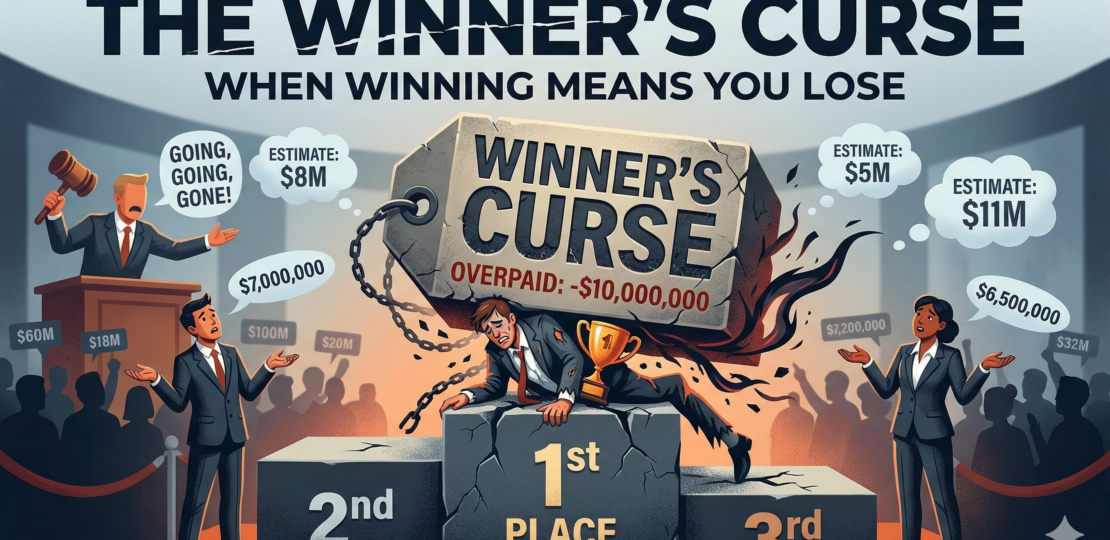
Economists studying these auctions discovered a pattern now known as the Winner’s Curse. In situations where the true value of something is uncertain—like an oil field or mineral deposit—each bidder makes an estimate. Some estimates will be too low, some too high. The bidder who wins is usually the one with the most optimistic estimate. In other words, the winner often wins because they overestimated the value.
Imagine ten companies estimating the value of an oil field. Most estimates cluster around $100 million, but one company believes it’s worth $160 million. That optimistic company bids the highest and wins the auction. Later drilling reveals the field was actually worth about $95 million. The victory becomes a financial loss.
This phenomenon doesn’t just appear in oil auctions. It shows up in corporate acquisitions, sports contracts, and even online bidding platforms. When many people compete for something with uncertain value, the act of winning can signal that you were the most overly optimistic participant in the room.
Economists eventually developed strategies to avoid the curse. Sophisticated bidders deliberately lower their bids to account for the risk that their estimate might be too high. This adjustment is sometimes called “bid shading.” The goal is not simply to win, but to win without overpaying.
The winner’s curse reveals a quiet truth about competition. Markets reward the highest bid, but the highest bid is not always the smartest one. Sometimes the most profitable decision in an auction is the hardest psychological move of all: letting someone else win.
RELATED POSTS
View all