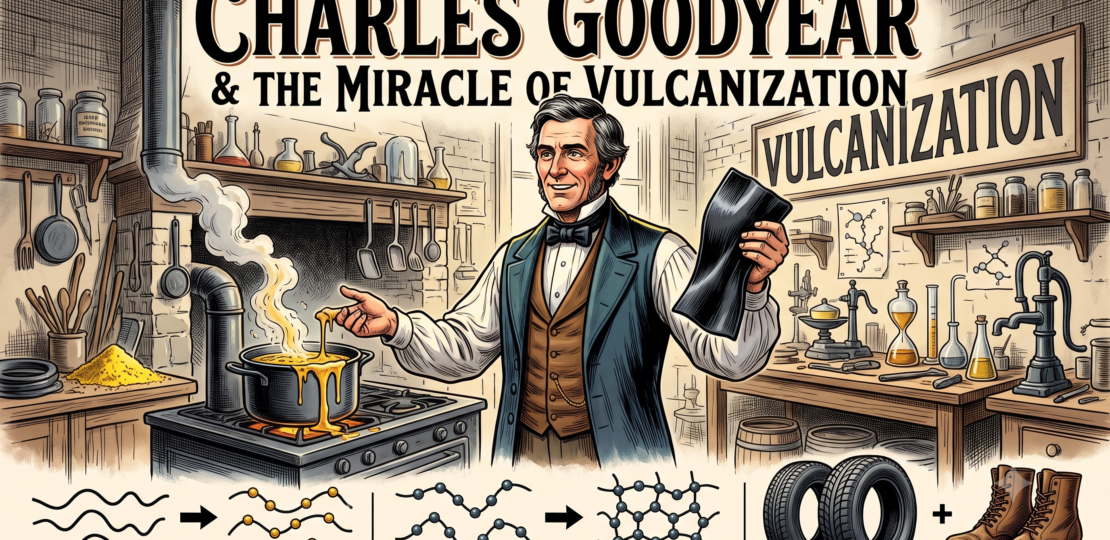
In the early 1800s, rubber was one of the most frustrating materials known to engineers. It was waterproof and flexible, but it had a fatal flaw. In the summer, it turned into a sticky, foul-smelling mess. In the winter, it became brittle and cracked. It was impossible to rely on for machines, clothing, or transportation. Inventors across Europe and America were racing to solve the problem, and most failed.
One of them was an American named Charles Goodyear. His obsession with rubber consumed his life. He borrowed heavily, spent time in debtor’s prison, and experimented relentlessly with hundreds of chemical mixtures. Friends thought he was ruining his future chasing an impossible dream. Years passed with little to show for it.
Then, in 1839, an accident changed everything.
According to the widely accepted account, Goodyear was demonstrating one of his latest rubber mixtures, which contained sulfur, when a piece accidentally fell onto a hot stove. Instead of melting into a sticky puddle—as rubber always did—it charred slightly but remained firm, flexible, and remarkably durable. Heat had triggered a chemical reaction between the sulfur and the rubber, creating tiny cross-links between the polymer chains. This process prevented the material from becoming soft in heat or brittle in cold.
Goodyear had stumbled upon what is now known as vulcanization.
The discovery transformed rubber from a scientific curiosity into one of the world’s most valuable engineering materials. Decades later, vulcanized rubber became the foundation of bicycle tires, automobile tires, industrial belts, electrical insulation, seals, hoses, medical equipment, footwear, and countless other products. Modern transportation and manufacturing would be almost unrecognizable without it. Ironically, despite his revolutionary discovery, Goodyear died in debt. The tire company bearing his name was founded years after his death and had no direct connection to him.
The story of Charles Goodyear is a reminder that breakthroughs are not always born from perfectly designed experiments. Sometimes they emerge from years of persistence meeting a single unexpected moment. The accident was only the spark. What mattered was that someone had spent years understanding the problem deeply enough to recognize that the accident had revealed an answer the world had been searching for.
RELATED POSTS
View all