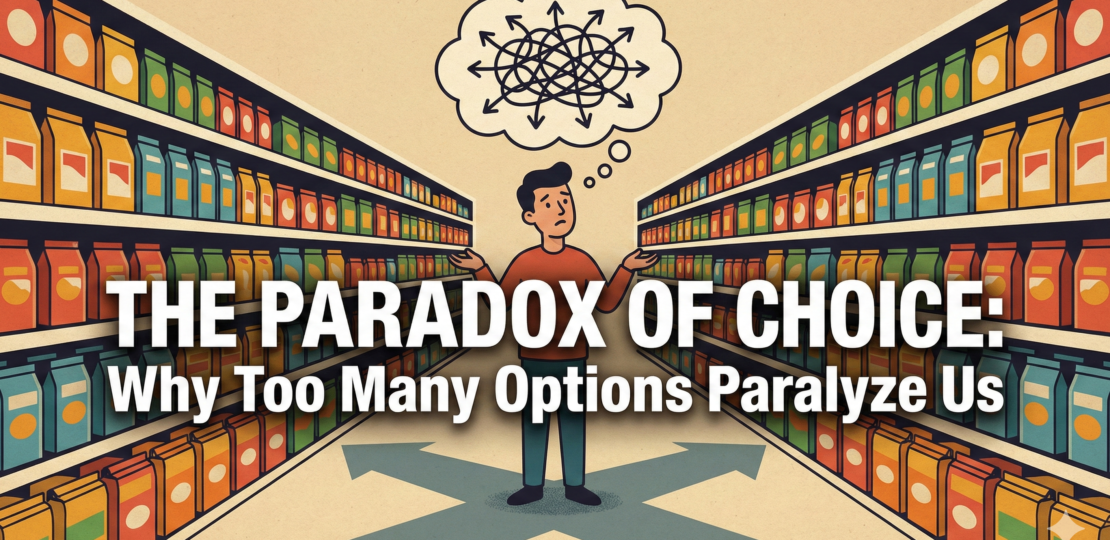
Behavioral psychology often uncovers truths that feel counterintuitive. One of the most surprising is how having more choices can actually make us less happy. Psychologists call this the paradox of choice: when options multiply, our minds struggle not only to pick but to feel satisfied with the pick we make. It turns out freedom is a double-edged sword.
Imagine walking into an ice cream shop with 5 flavors versus 50. With 5, the decision is quick, and even if the choice isn’t perfect, we rarely regret it. With 50, the brain begins running cost–benefit calculations at every turn. “What if a better flavor exists?” “Did I settle too soon?” The mind treats the abundance not as liberation, but as a subtle form of pressure. Behavioral experiments consistently show that people offered too many options are more likely to delay, avoid, or regret decisions.
Part of the reason lies in human loss aversion. Each additional choice increases the potential for regret, and our brains weigh potential losses more heavily than potential gains. The more we have, the more we imagine what we’re missing, creating a mental friction that slows decision-making. Satisfaction isn’t just about picking the “best” option; it’s about escaping the endless calculus of “what ifs.”
Interestingly, this has implications far beyond ice cream. From consumer goods to career paths, even dating apps, behavioral psychology suggests that trimming options—or setting clear decision frameworks—can improve outcomes and emotional well-being. In a way, the mind prefers constraints over chaos, clarity over abundance. The lesson is simple yet profound: freedom without guidance can feel like captivity, and knowing how much choice is enough might be one of life’s underrated skills.
RELATED POSTS
View all