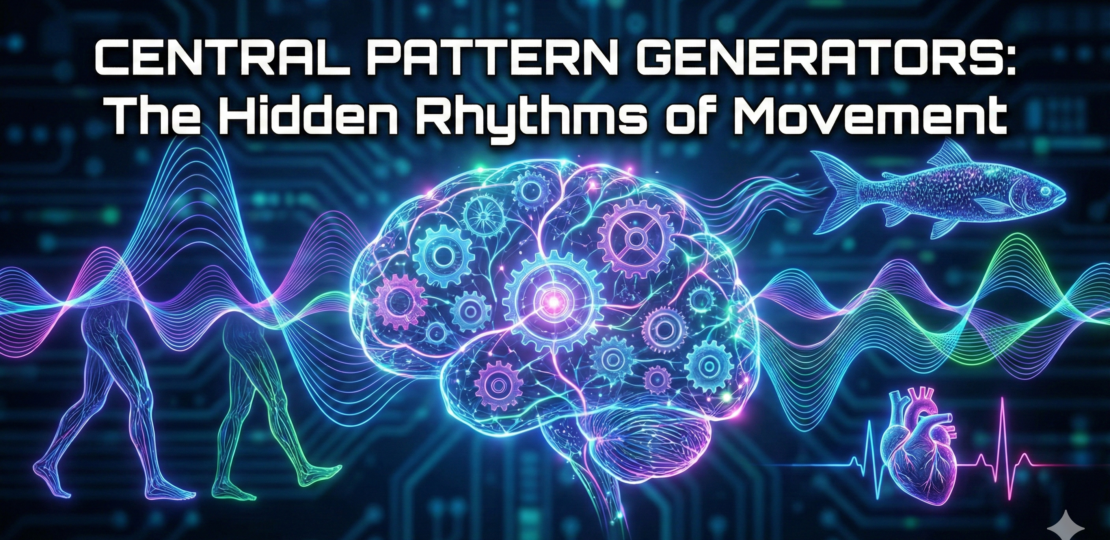
Walking feels voluntary. You decide to move, and your legs obey. Simple story. Except it isn’t.
Deep inside your spinal cord live networks of neurons called central pattern generators (CPGs). These circuits can produce rhythmic, patterned movements—like walking, breathing, chewing—without needing constant instructions from your brain. Once activated, they generate the rhythm automatically.
This was discovered in animal studies where researchers found that even when connections to the brain were disrupted, the spinal cord could still produce stepping motions on a treadmill. The rhythm wasn’t coming from conscious thought. It was embedded in the circuitry itself. The brain initiates and modulates. The spinal cord runs the loop.
Breathing is another example. You can control it deliberately for a while. But stop paying attention and the pattern continues. That rhythm emerges from neural oscillators—groups of neurons that fire in repeating cycles. It’s biological metronome work.
The implications are quietly radical. Not all movement requires conscious command. Much of what you experience as “I am doing this” is actually layered control: top-down intention riding on bottom-up automation. Your nervous system is hierarchical. Conscious thought sets goals. Subcortical circuits execute patterns.
There’s something humbling here. The sense of agency feels central to identity. Yet much of your action emerges from ancient spinal programs that predate reflective thought by hundreds of millions of years. You are, in part, a rhythmic organism—patterns nested inside patterns. And your conscious mind? It’s less a puppet master and more a conductor stepping in when improvisation is needed.
RELATED POSTS
View all