Imagine looking down at your hand and watching it grow larger and larger.
Not in reality, of course. Everyone around you sees the same hand they always have. Yet to you, it suddenly appears enormous, as though it belongs to a giant. Moments later, the opposite occurs. Your hand seems tiny, distant, almost detached from your body.
As strange as it sounds, experiences like these have been documented for more than a century. They are part of a rare neurological condition known as Alice in Wonderland Syndrome, named after Lewis Carroll’s famous novel, in which Alice repeatedly grows and shrinks after consuming mysterious foods and drinks.
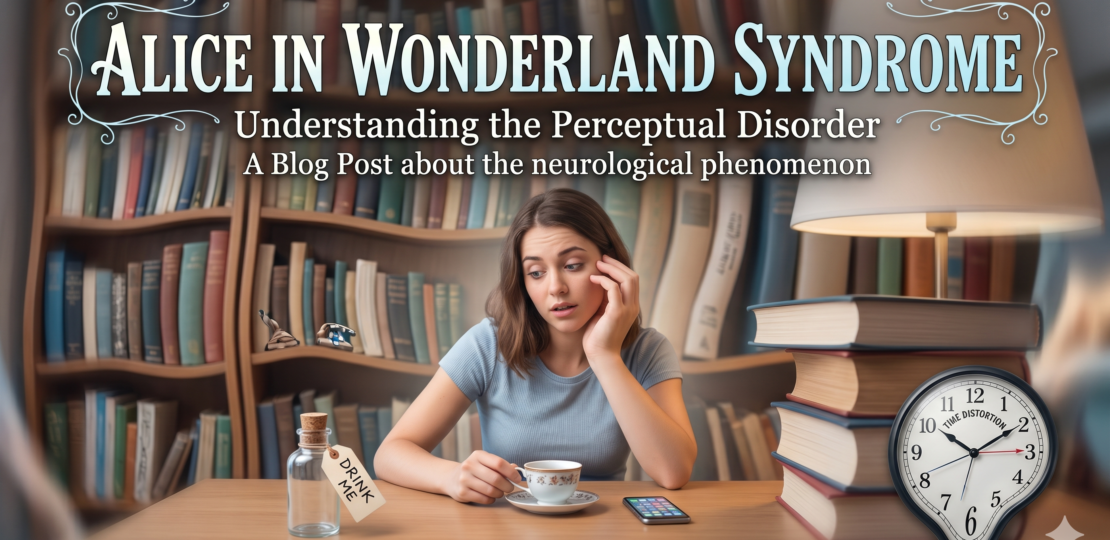
The syndrome affects perception rather than vision itself. During an episode, people may perceive objects as much larger than they actually are, a phenomenon known as macropsia. Others experience micropsia, in which objects appear unusually small. Distances can seem distorted, rooms may appear stretched or compressed, and even the size of one’s own body can feel altered. Some individuals also report changes in their perception of time, describing moments that seem to slow dramatically or speed up.
What makes the condition particularly fascinating is that those experiencing it are often aware that something is wrong. They know their hand has not actually doubled in size. They know the hallway has not suddenly become twice as long. Yet the perception remains convincing. The brain continues presenting a version of reality that conflicts with everything else they know.
Researchers have linked Alice in Wonderland Syndrome to several neurological conditions, most notably migraines. It has also been observed in association with epilepsy, viral infections, and other disruptions affecting the brain’s processing of sensory information. Although the exact mechanisms remain under investigation, many scientists believe the syndrome arises from temporary disturbances in the neural networks responsible for integrating visual and spatial information.
The condition offers an unusual glimpse into how perception works. Most of the time, we assume that seeing is a straightforward process: light enters the eyes and the brain receives an accurate picture of reality. Modern neuroscience suggests something more complicated. The brain does not merely observe the world. It actively constructs an interpretation of it using incoming sensory data.
Alice in Wonderland Syndrome reveals this process by showing what happens when that construction becomes unstable. The eyes may be functioning normally, yet the brain’s interpretation of size, distance, and space begins to drift from reality. The result is a world that feels dreamlike despite being physically unchanged.
The syndrome remains rare, and many clinicians will never encounter a case firsthand. Yet its existence raises an intriguing possibility. The world we experience is not reality itself, but a model of reality generated by the brain. Most of the time, that model is remarkably accurate. Occasionally, conditions such as Alice in Wonderland Syndrome remind us that even our most basic perceptions depend on an intricate system quietly operating behind the scenes.
For most people, the idea of a room suddenly expanding or a hand unexpectedly shrinking belongs in a work of fiction. For a small number of individuals, however, it is a real experience—one that reveals just how much of everyday perception is constructed rather than directly observed.
RELATED POSTS
View all