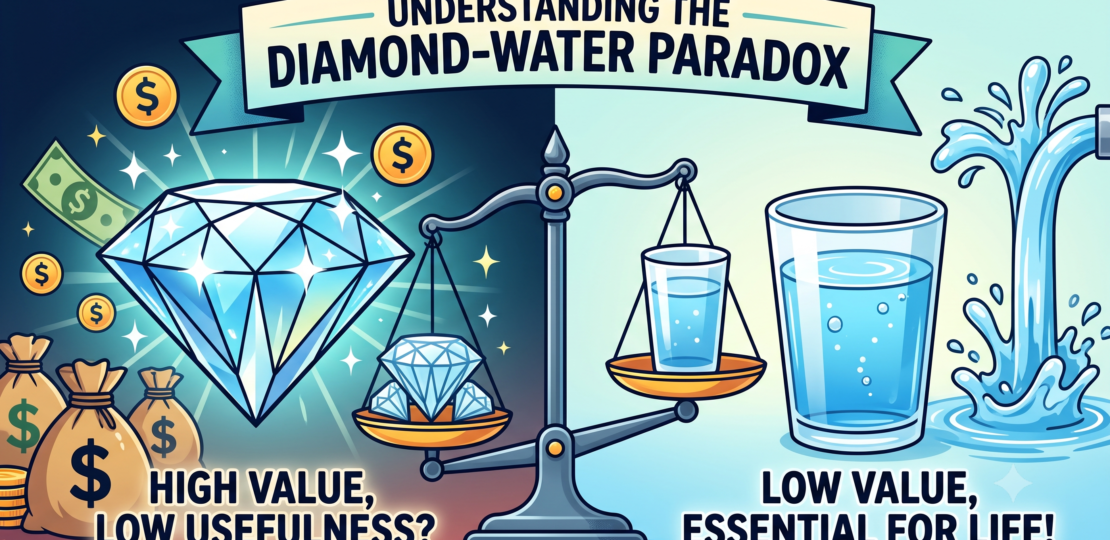
Water is essential for life.
Diamonds are not.
Without water, human civilization would collapse within days. Without diamonds, life would continue almost unchanged. Yet in nearly every market, a diamond is worth far more than an equivalent amount of water. Why?
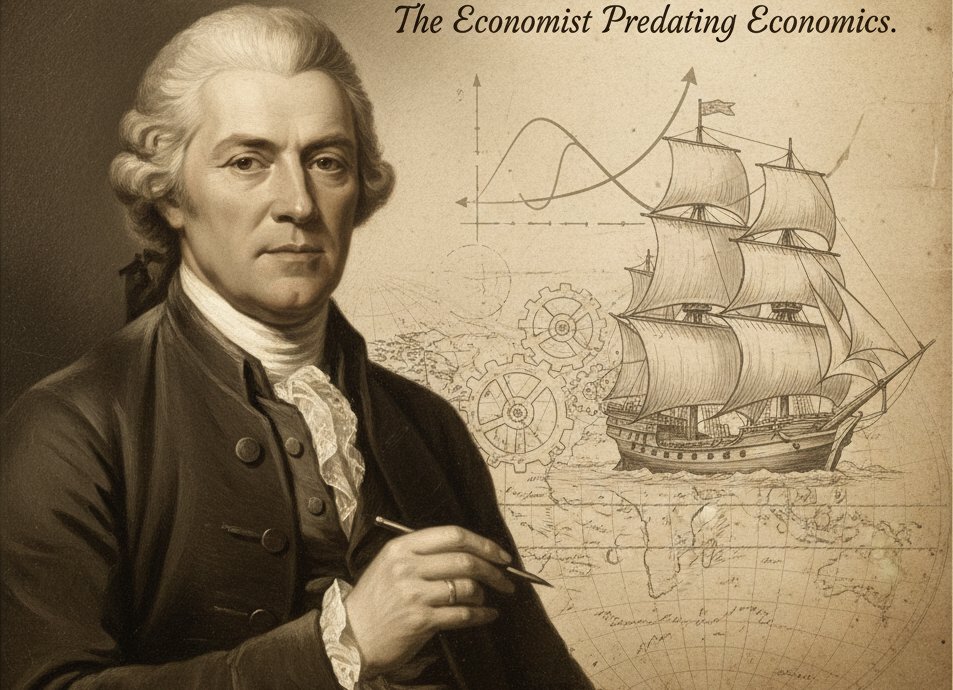
This question puzzled economists for centuries and became known as the Diamond-Water Paradox. It was famously discussed by Adam Smith in The Wealth of Nations (1776), where he observed that “nothing is more useful than water; but it will purchase scarce anything… A diamond, on the contrary, has scarce any value in use, but a very great quantity of other goods may frequently be had in exchange for it.” At first glance, this appears to contradict common sense. If value is determined by usefulness, water should be one of the most expensive commodities on Earth.
The solution arrived nearly a century later through the work of economists including William Stanley Jevons, Carl Menger, and Léon Walras, who independently developed the theory of marginal utility. Their insight was that prices are not determined by the total usefulness of a good, but by the value of obtaining one additional unit of it. Water, despite being indispensable, is abundant in most places. Because people already have enough to satisfy their most important needs, an extra litre provides relatively little additional benefit. Diamonds, in contrast, are scarce. Even though they contribute little to survival, obtaining one more diamond is far more difficult, making its marginal value much higher.
This distinction between total utility and marginal utility transformed economic thought. Imagine standing beside a river with an endless supply of clean water. Receiving one more bottle changes very little. Now imagine owning a single diamond. Receiving a second one meaningfully increases your collection because diamonds remain scarce. The market reflects this trade-off between scarcity and the value of the next unit consumed, not the importance of the good itself.
The paradox also explains why prices can change dramatically depending on circumstances. A bottle of water at home costs very little because supply is plentiful. The same bottle in the middle of a desert, after hours without hydration, may become more valuable than jewelry. The water itself has not changed. What has changed is its marginal utility. As availability decreases, each additional unit becomes more valuable because it satisfies a more urgent need.
The Diamond-Water Paradox remains one of the most influential ideas in economics because it distinguishes between value and price. Markets do not measure how important something is to human life. They measure how people value one additional unit under existing conditions of scarcity. This principle extends far beyond water and diamonds. It helps explain wages, housing prices, collectibles, natural resources, and countless everyday transactions.
What began as a simple question—why are diamonds worth more than water?—ultimately reshaped economics. The answer is not that diamonds are more important. It is that markets respond to scarcity at the margin, not necessity as a whole. Sometimes, the things we cannot live without are inexpensive precisely because they are abundant, while the things we could easily live without become extraordinarily valuable simply because they are rare.
RELATED POSTS
View all