One of the first ideas taught in economics is the law of demand: as prices rise, demand falls. It seems intuitive. If the price of a product doubles, fewer people are willing or able to buy it. Yet economists have identified rare situations where the opposite occurs—higher prices lead to greater demand.
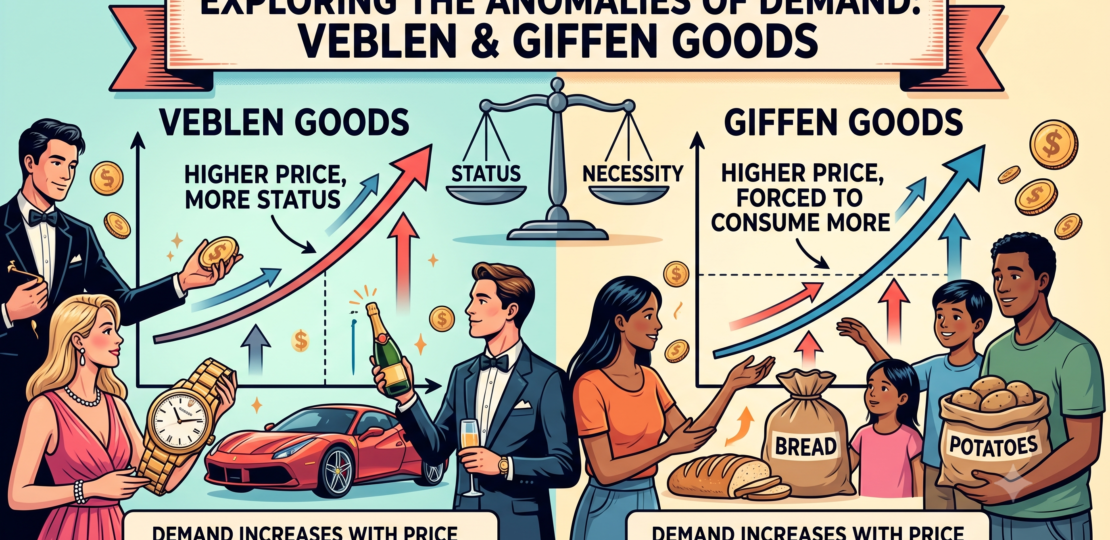
One explanation is the Veblen good, named after economist Thorstein Veblen, who introduced the idea in The Theory of the Leisure Class (1899). Certain luxury goods derive part of their appeal from their high price. Expensive watches, designer handbags, and exclusive automobiles are often purchased not only for their quality, but because their cost signals wealth, status, or exclusivity. If these products were sold at a fraction of their original price, they could lose much of the prestige that makes them desirable. In these cases, a higher price can increase demand because it strengthens the product’s perceived value as a status symbol.
A different and even rarer case is the Giffen good, named after economist Sir Robert Giffen. A Giffen good is typically an inexpensive staple food consumed by low-income households. When the price of the staple rises, families have less income available for more expensive foods such as meat or vegetables. Instead of buying less of the staple, they purchase even more of it because it becomes the only affordable way to meet their basic nutritional needs. Although genuine examples are uncommon, research by economists Robert Jensen and Nolan Miller found evidence of Giffen behavior among some low-income households in parts of rural China, where rising prices of staple foods led to increased consumption under specific conditions.
These two phenomena arise for entirely different reasons, yet both challenge one of economics’ most familiar principles. Veblen goods demonstrate that consumers sometimes buy products to communicate social status, while Giffen goods reveal how financial constraints can force households into counterintuitive purchasing decisions. Together, they illustrate that price is more than a measure of cost—it can also convey information about prestige, necessity, and scarcity.
The existence of Veblen and Giffen goods does not overturn the law of demand. Instead, they highlight that economic principles describe general patterns rather than universal rules. Human behavior is shaped not only by prices, but also by income, incentives, and social context. Occasionally, those forces align in ways that make the seemingly impossible entirely consistent with economic theory.
RELATED POSTS
View all