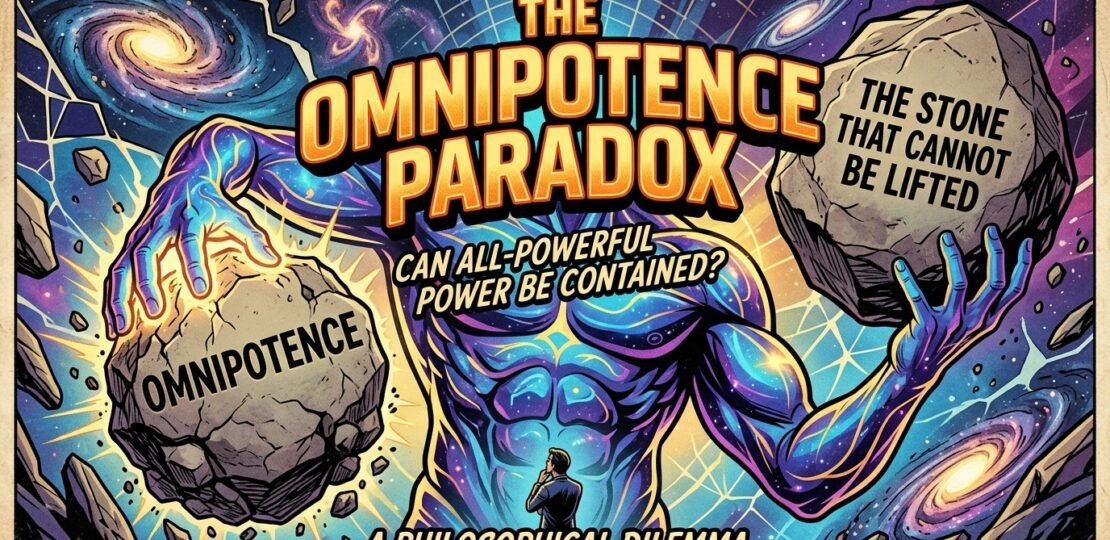
Imagine an all-powerful being—one capable of doing absolutely anything. Now ask a seemingly simple question: Can this being create a stone so heavy that it cannot lift it? If the answer is yes, then there is something it cannot do: lift the stone. If the answer is no, then there is also something it cannot do: create the stone. Either way, the idea of unlimited power appears to contain a contradiction.
This is known as the Omnipotence Paradox, a philosophical problem that has been discussed for centuries in debates about the nature of God and the meaning of omnipotence. At first, it looks like a clever word game, but it exposes a deeper problem: what does it actually mean to be capable of doing anything? If “anything” includes logically contradictory actions, then the definition itself may be impossible to satisfy.
One common response is that omnipotence does not mean the ability to make contradictions true. An all-powerful being could create any physically possible object, but it could not create a “square circle” because the phrase describes no coherent thing. Similarly, creating an unliftable stone for a being capable of lifting every possible stone may not be a genuine task at all. The limitation would not come from insufficient power, but from the request itself having no logically consistent meaning.
That distinction changes the question completely. Consider asking someone to “build a triangle with four sides.” Their inability to do so does not demonstrate a lack of engineering ability. There is simply no object satisfying those conditions. The paradox therefore becomes less about how much power someone possesses and more about whether
language can construct a meaningful task simply by putting contradictory words together.
The Omnipotence Paradox ultimately reveals a curious boundary between power and logic. We often think of unlimited ability as meaning that every imaginable action must be possible, but imagination can produce descriptions that contradict themselves. Perhaps true omnipotence does not mean being able to do absolutely everything we can say, but being able to do everything that can meaningfully be done. The more interesting question, then, is not whether an all-powerful being can lift the stone, but whether a logically impossible stone was ever something that could exist in the first place.
RELATED POSTS
View all