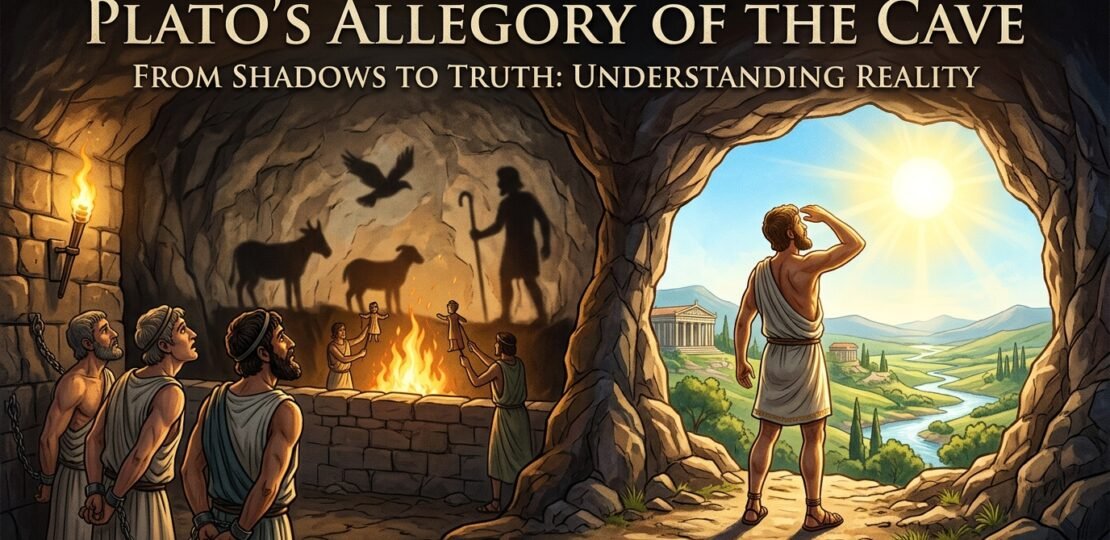
Imagine a group of people who have spent their entire lives chained inside a dark cave. They cannot turn around. Behind them is a fire, and between the fire and the prisoners, other people carry objects. The prisoners can see only the shadows cast onto the wall in front of them. Having never seen anything else, they naturally assume that these shadows are reality.
This is Plato’s Allegory of the Cave, described in The Republic more than two thousand years ago. The story becomes more interesting when one prisoner is freed. At first, the outside world is painful and confusing. Sunlight hurts their eyes, and the objects that once seemed obvious turn out to be very different from the shadows they had known. Eventually, they see the sun itself and understand that their previous conception of reality was profoundly incomplete.
If the prisoner returns to the cave and tries to explain what was outside, the others would have little reason to believe them. Their entire understanding of the world has been built around the shadows. To them, the person who claims that another reality exists might simply appear confused or delusional. The problem is not that they are unwilling to learn; they have never encountered evidence that would force them to question what they already know.
Plato used the cave to explore knowledge, education, and the difference between appearance and reality. But the thought experiment raises a problem that remains relevant far beyond ancient Greece: how can someone recognize the limits of their own understanding when everything they know seems to confirm it? A person can only question assumptions that they are capable of noticing, and the assumptions that shape our worldview are often the ones we never think to examine.
The unsettling possibility is that every person lives with their own version of the cave. Culture, education, experience, technology, and the people around us determine which parts of reality become visible and which remain outside our attention. Escaping the cave does not necessarily mean discovering some final, perfect truth. It may simply mean recognizing that the wall in front of us is not necessarily the whole world.
RELATED POSTS
View all