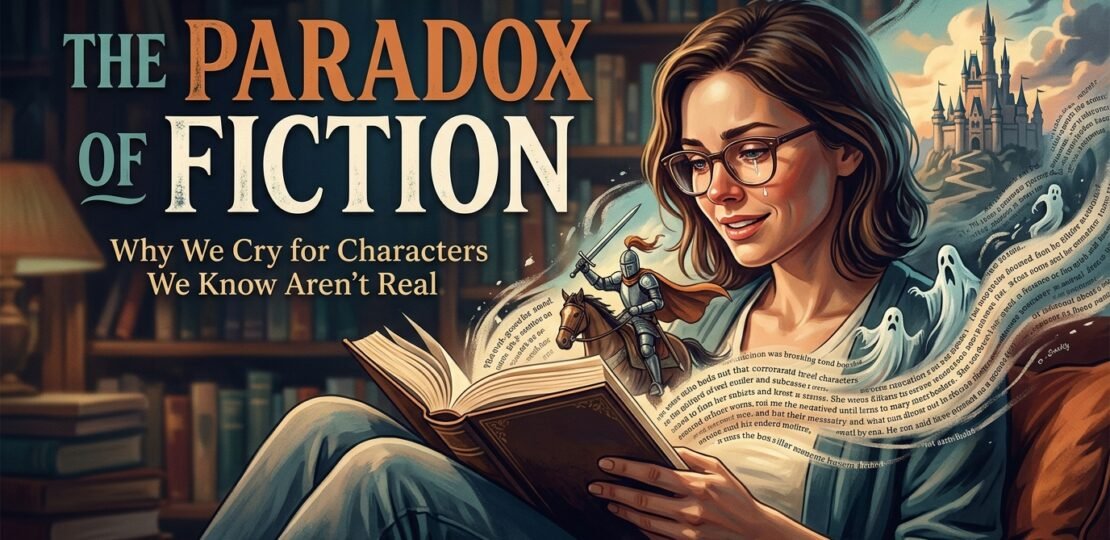
Imagine reading a novel in which the protagonist dies in the final chapter. You know the character never existed, and you understand that every event was invented by an author. Yet when death occurs, you feel genuine sadness. Your heart sinks, you may even cry, and for a moment, the fate of an imaginary person seems to matter deeply. Why should something you know to be unreal produce an emotion that is entirely real?
This is known as the Paradox of Fiction, a philosophical puzzle about why humans experience genuine emotions in response to imaginary people and events. It appears everywhere: audiences fear for characters in horror films, celebrate fictional victories, and grieve over endings despite knowing that the actors will return to their ordinary lives once the cameras stop rolling. The emotions are not necessarily deliberate. A person can know perfectly well that a film is fictional and still instinctively react to what happens on screen.
One proposed explanation is that emotional responses do not always depend on believing something is real. A frightening image can trigger fear before the mind has finished evaluating whether danger exists. Similarly, a fictional character can become emotionally significant through familiarity, empathy, and imagination, even when we never believe the character exists. Another possibility is that stories allow us to simulate situations involving people and experiences that matter to us, activating emotional responses without requiring the events themselves to be real.
The deeper difficulty is that philosophers often connect emotions to beliefs and desires. We fear things we believe may harm us, and we grieve over losses we believe have occurred. Yet fictional characters seem to challenge this relationship: we do not believe that the character is actually suffering, but we respond as though their suffering matters. Perhaps our emotional systems operate differently from our rational judgments, or perhaps there are several kinds of belief and engagement that do not fit neatly into a single explanation.
The paradox also raises a question about the value of art. If fictional suffering can move us, fictional courage can inspire us, and fictional relationships can change how we understand our own, then the boundary between imagination and reality is not the same as the boundary between what matters and what does not. The events may be invented, but their effects on the audience are not. Perhaps a story does not need to be real to reveal something true about the people who experience it.
RELATED POSTS
View all