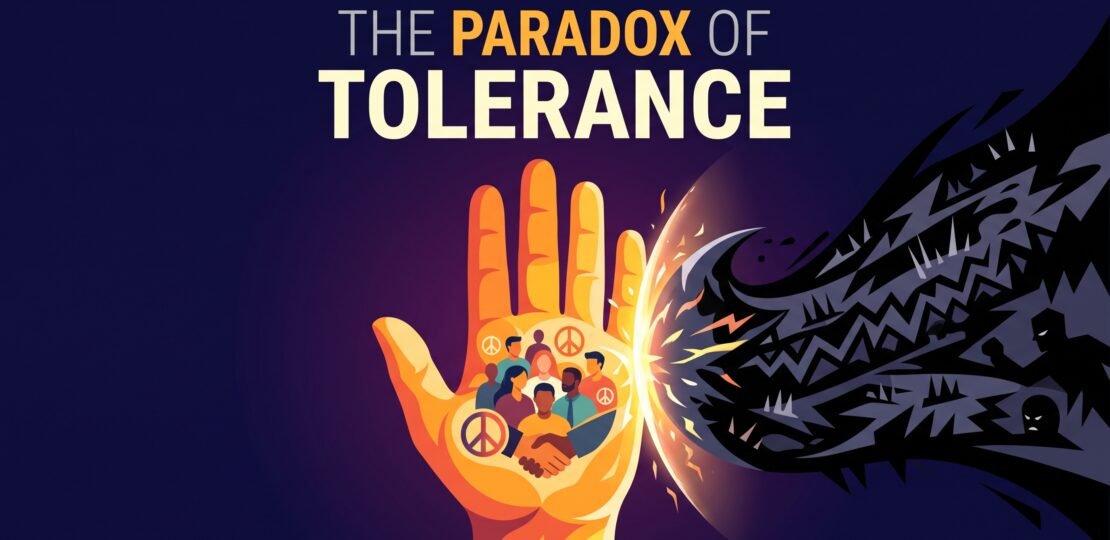
Imagine a society that believes every person should be free to express their opinions, regardless of how unpopular those opinions may be. Its citizens tolerate political disagreement, religious differences, and criticism of their institutions. But one group begins using that freedom to spread hatred, silence opponents, and demand that certain people lose their rights. If the society continues tolerating the group, it may eventually allow the destruction of the very freedoms that made tolerance possible.
This is the Paradox of Tolerance, explored by philosopher Karl Popper in his 1945 book The Open Society and Its Enemies. Popper argued that a completely unrestricted tolerance could ultimately lead to the disappearance of tolerance itself. If a tolerant society permits intolerant movements to destroy its institutions and suppress dissent, then tolerance can become the instrument of its own destruction.
The difficulty lies in deciding where tolerance should end. Disagreeing with an idea is not the same as suppressing it, and an unpopular opinion is not necessarily a threat to society. If every offensive statement were treated as an attack on tolerance, the principle could become an excuse for censorship. Yet if a society refuses to defend itself against movements that seek to eliminate the rights of others, it risks allowing intolerance to gain power under the protection of freedoms it does not intend to preserve.
Popper did not argue that every intolerant opinion should immediately be prohibited. His concern was particularly directed toward movements that reject rational discussion and seek to impose their views through violence or coercion. The distinction matters because defending tolerance does not necessarily require abandoning tolerance; it may require defending the conditions that allow people with different beliefs to coexist in the first place.
The paradox ultimately raises a difficult question about the limits of freedom. A society cannot remain open merely by declaring that everyone is free; it must also consider what happens when that freedom is used to eliminate the freedom of others. But deciding when a genuine threat has emerged—and who gets to make that decision—is itself a source of danger. How much intolerance should a tolerant society tolerate before its tolerance becomes a threat to its own survival?
RELATED POSTS
View all