Walking seems like a problem that should require sophisticated control. A human constantly adjusts balance, changes the position of their feet, and responds to uneven ground without consciously calculating every movement. For decades, engineers trying to build walking robots approached the problem with increasingly complicated control systems. But one of the most influential ideas in robotics came from asking whether the machine could simply be designed so that physics did most of the work.
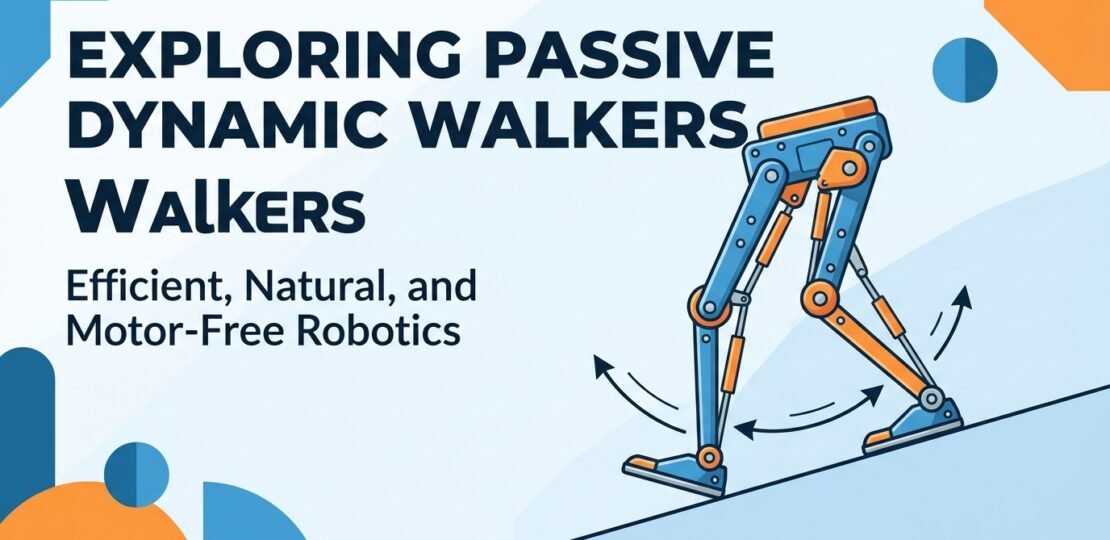
A passive dynamic walker can walk down a slight slope without motors, sensors, or a computer controlling each step. Its legs are carefully shaped and connected so that gravity causes them to swing forward and backward in a natural sequence. As one leg falls and contacts the ground, the motion transfers through the mechanism and initiates the next step. The machine effectively converts gravitational potential energy into walking motion.
The remarkable part is that the machine does not calculate how to walk. Its structure determines much of its behavior. The length and mass of each leg, the position of the joints, and the geometry of the feet determine how the walker moves. Instead of programming every movement, engineers design the mechanical system so that a stable walking pattern naturally emerges from the interaction between gravity, inertia, and the ground.
This approach is closely connected to the idea of embodied intelligence. Some behaviors that appear to require intelligence can instead emerge from the physical properties of a system. A well-designed mechanical structure can automatically respond to disturbances without explicitly sensing them. If the machine begins to tilt, the motion of its legs and body can sometimes naturally bring it back toward a stable trajectory.
Modern walking robots generally require motors, sensors, and sophisticated control algorithms because they need to operate on level ground, climb obstacles, carry loads, and adapt to unpredictable environments. Passive walkers cannot do all of this. Their usefulness lies elsewhere: they reveal how much of walking can be produced by mechanics alone.
The deeper lesson is that engineering does not always mean adding more technology. Sometimes it means discovering which technology is unnecessary. A computer can be replaced by geometry, a sensor by a carefully positioned mass, and a complicated algorithm by the natural behavior of a mechanical system. The machine walks not because it has been taught how to walk, but because it has been built in a way that makes walking the natural thing for it to do.
RELATED POSTS
View all