Series: The Return Equation
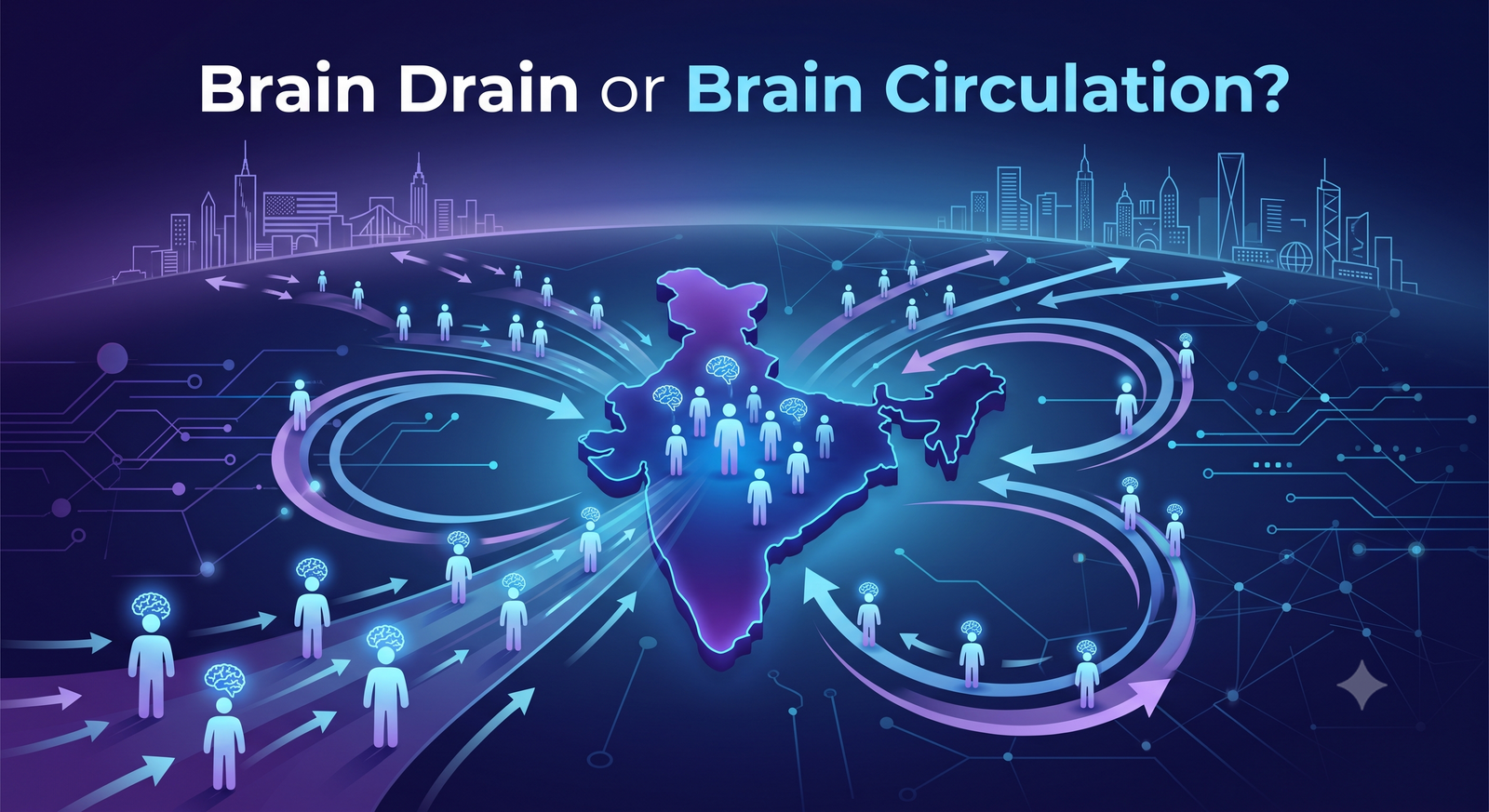
Throughout this series, one assumption has quietly remained unquestioned: that countries succeed by keeping talented people within their borders. It is an understandable assumption. Every departure appears to represent a loss, while every return feels like a gain. Yet in an increasingly interconnected world, perhaps the question deserves to be asked differently. Must a country’s success really be measured by where its talented people live?
For most of human history, the answer was probably yes. Scientists worked where their laboratories were located. Professors taught only those who could physically attend their universities. Entrepreneurs built companies where they resided. Geography largely determines contribution. Today, that relationship has weakened. Researchers collaborate across continents. Engineers contribute to international teams. Investors fund startups thousands of kilometres away. Professors teach students they may never meet in person. Knowledge has never needed a passport, and ideas have never stopped at immigration checkpoints.
This has created something that previous generations rarely experienced: the emergence of the global professional. Consider an engineer born in Chennai, educated in Bengaluru, pursuing a doctorate in Germany, working in California, investing in startups in Hyderabad, mentoring engineering students online, and collaborating with researchers at IITs. Which country truly benefits from that individual? The answer is no longer straightforward. In a connected world, contribution is increasingly detached from geography.
Perhaps, then, countries have been measuring the wrong thing. Public discussion often focuses on how many talented people leave, yet far less attention is given to what eventually flows back. Investment, research collaborations, professional networks, entrepreneurial experience, mentorship, and technological expertise all cross borders in ways that migration statistics struggle to capture. People move, but so do ideas. In many cases, ideas travel much farther.
This changes the way patriotism itself can be understood. Patriotism is often associated with remaining within one’s country, but contribution is not confined by national borders. An entrepreneur creating jobs, a scientist advancing knowledge, a teacher inspiring future generations, or an investor funding innovation can strengthen their country regardless of where they happen to live. Geography may influence where opportunity is found, but it does not necessarily determine where value is created.
None of this suggests that geography has become irrelevant. Countries still compete intensely for researchers, entrepreneurs, engineers, artists, and innovators because talent remains one of the world’s most valuable resources. But perhaps the nature of that competition has changed. It is no longer simply about preventing people from leaving. It is about creating an environment that continually attracts talent, welcomes talent back, and remains connected to those who build their lives elsewhere. Countries do not own talent. They earn it.
India occupies a uniquely interesting position in this landscape. It has one of the world’s largest diasporas, one of its youngest populations, a rapidly expanding economy, internationally recognised technology industries, and growing influence in science, manufacturing, and entrepreneurship. These strengths should not be viewed as separate advantages. Together, they form a global network whose potential extends well beyond India’s borders. The question is no longer whether India can benefit from both those who stay and those who leave. It already does. The greater challenge is ensuring that those connections become stronger with each passing generation.
Perhaps that is the real lesson of this discussion. Brain drain remains a useful concept, but it is no longer sufficient to describe the movement of talent in the twenty-first century. A country’s future will not be determined solely by how many talented people remain within its borders. It will also be shaped by how effectively it transforms a global community of people into a global community of contributors.
The objective, then, is not to build a country from which nobody leaves. It is to build a country that people continue to invest in, collaborate with, and remain proud to be connected to—wherever in the world they may be.
RELATED POSTS
View all