Series: The Return Equation
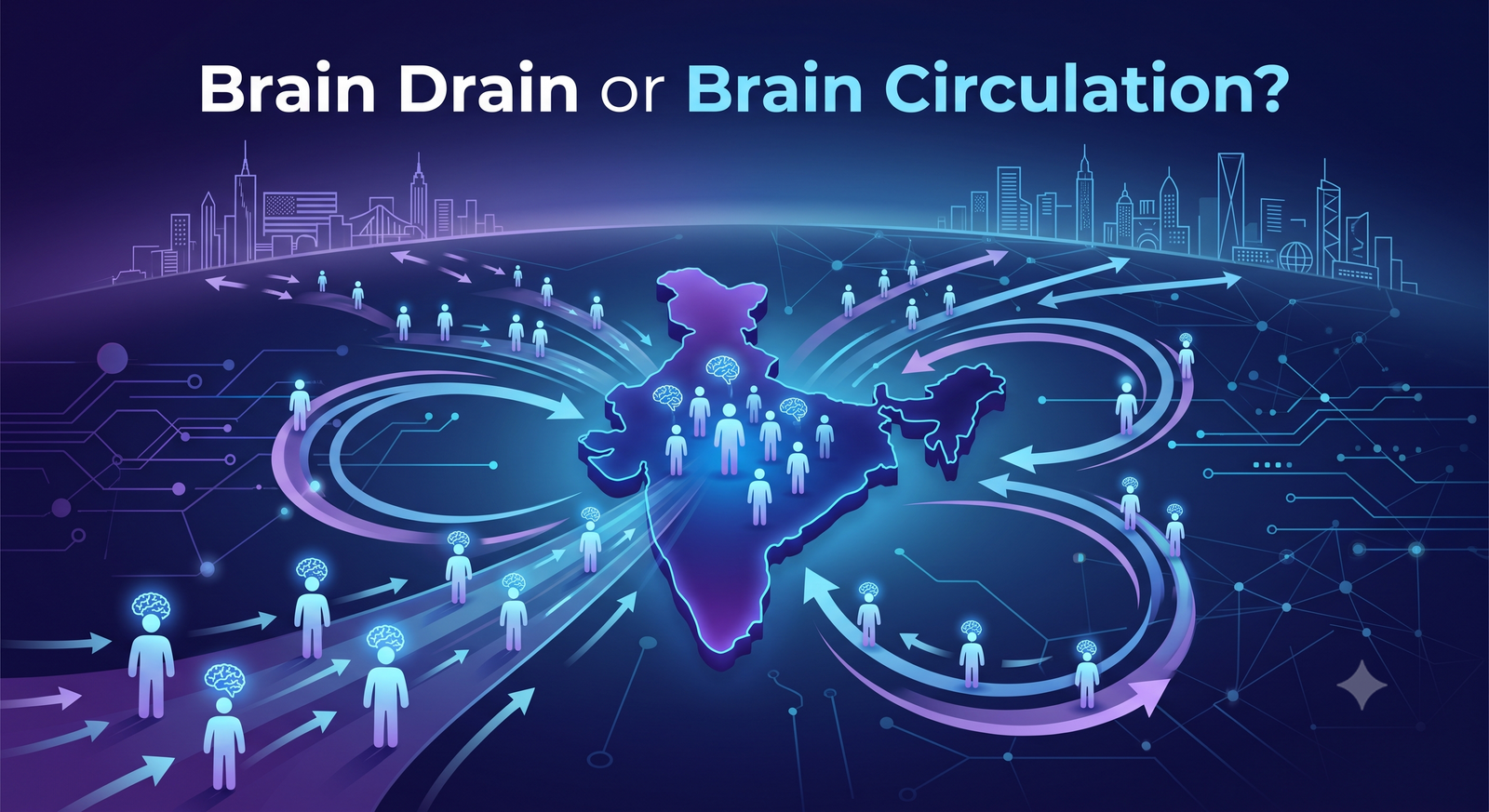
Throughout this series, one conclusion has emerged repeatedly: people rarely migrate for a single reason. Financial incentives matter, but so do careers, education, institutions, family, lifestyle, and opportunity. If brain drain is driven by many factors, then there can never be a single solution. The question is therefore not how India can stop migration, but how it can become a country that talented people increasingly choose to stay in—or return to.
Financial incentives will almost certainly remain the single biggest reason people migrate. For most middle-class families, migration is first and foremost an economic decision. Higher salaries promise financial security, faster wealth accumulation, better retirement planning, and the ability to support parents or future children. India cannot realistically outpay the United States, Switzerland, or several other developed economies, nor should that become the objective. Instead, the long-term goal should be to narrow the gap while simultaneously creating opportunities that make the trade-off less one-sided. People may initially migrate for money, but whether they stay or return increasingly depends on everything that follows. A competitive salary opens the door; a fulfilling career gives people a reason to remain.
Meaningful careers are the next piece of the puzzle. Throughout history, talent has gravitated towards places where ambitious problems are being solved. Scientists move towards well-funded laboratories. Entrepreneurs move towards thriving startup ecosystems. Engineers move towards industries pushing the boundaries of what is possible. India’s continued investment in sectors such as semiconductors, advanced manufacturing, defence, biotechnology, artificial intelligence, and private space is therefore far more than an economic strategy—it is a talent strategy. People rarely dedicate decades of their lives to salaries alone. They dedicate them to problems worth solving.
Strong careers, however, depend upon strong institutions. An entrepreneur should spend more time building a company than obtaining approvals. A researcher should spend more time conducting experiments than navigating paperwork. An engineer should not lose months waiting for equipment trapped in administrative processes. Bureaucracy rarely creates innovation. It determines how difficult innovation becomes. Simplifying regulations, reducing unnecessary administrative friction, and making government processes faster and more transparent would improve the experience of every professional, regardless of whether they were born in India or abroad.
Closely connected to bureaucracy is corruption. While India has made significant progress through digital governance and online public services, corruption remains a reality that affects confidence in institutions. The issue is not merely financial loss; it is unpredictability. When outcomes depend upon personal discretion rather than transparent processes, long-term planning becomes more difficult for researchers, entrepreneurs, and investors alike. Reducing corruption is therefore not only an ethical objective—it is an economic one. Every process that becomes transparent, time-bound, and digitally accountable removes another barrier between an idea and its execution.
Education may represent India’s greatest long-term opportunity. Throughout this series, one recurring reason families hesitate to return has been concern for their children’s education. While India’s universities continue to produce exceptionally talented graduates, much of the school system remains associated with examination-driven learning and rote memorisation. The National Education Policy has begun shifting towards multidisciplinary education, flexibility, and critical thinking, but reforms of this scale require consistent implementation over many years. Future reforms should continue encouraging project-based learning, undergraduate research, stronger laboratories, industry partnerships, and classrooms where curiosity is rewarded as much as correct answers. Parents should never feel that providing the best possible education for their children requires leaving the country. Education should become one of India’s greatest reasons to stay, not one of its strongest reasons to leave.
Research deserves similar attention. India currently spends roughly 0.6–0.7% of its GDP on research and development, substantially below countries such as South Korea, Israel, Germany, and the United States. That difference is reflected not only in scientific output, but also in the kinds of careers available to researchers and engineers. Whether the field is aerospace, biotechnology, quantum computing, or artificial intelligence, ambitious researchers naturally gravitate towards environments that consistently invest in discovery. Laboratories, doctoral programmes, high-risk research grants, and stronger collaboration between universities and industry all determine whether talented scientists believe they can pursue world-class research without leaving India. If India hopes to become a scientific and technological superpower, research funding cannot remain an afterthought.
Quality of life also deserves greater attention. Migration decisions eventually become family decisions, and families compare much more than salaries. Air quality, public transport, healthcare, schools, green spaces, housing, safety, and urban planning all influence where people choose to build a future. People do not experience countries. They experience cities. The decision to remain in a country is ultimately a decision to wake up there every morning.
Finally, India should continue strengthening its relationship with the millions of Indians already living abroad. Not everyone needs to return permanently for India to benefit. Visiting professorships, collaborative research, startup investment, mentorship programmes, diaspora venture funds, and simplified pathways for overseas Indians to contribute can all transform brain drain into brain circulation. India’s diaspora should not simply be viewed as citizens living elsewhere. It should be viewed as one of the country’s greatest strategic assets.
Patriotism undoubtedly inspires many people to contribute to India. Yet patriotism alone cannot compensate for opportunities that do not exist. A nation should never ask its brightest minds to choose between serving their country and fulfilling their potential. Its responsibility is to make those two ambitions the same.
None of these changes will eliminate migration, nor should that be the objective. Throughout history, talented people have always moved towards opportunity, and they always will. The real measure of success is not how few people leave. It is whether India continues becoming a country where ambitious people no longer feel they have to leave in order to fulfil their potential.
RELATED POSTS
View all