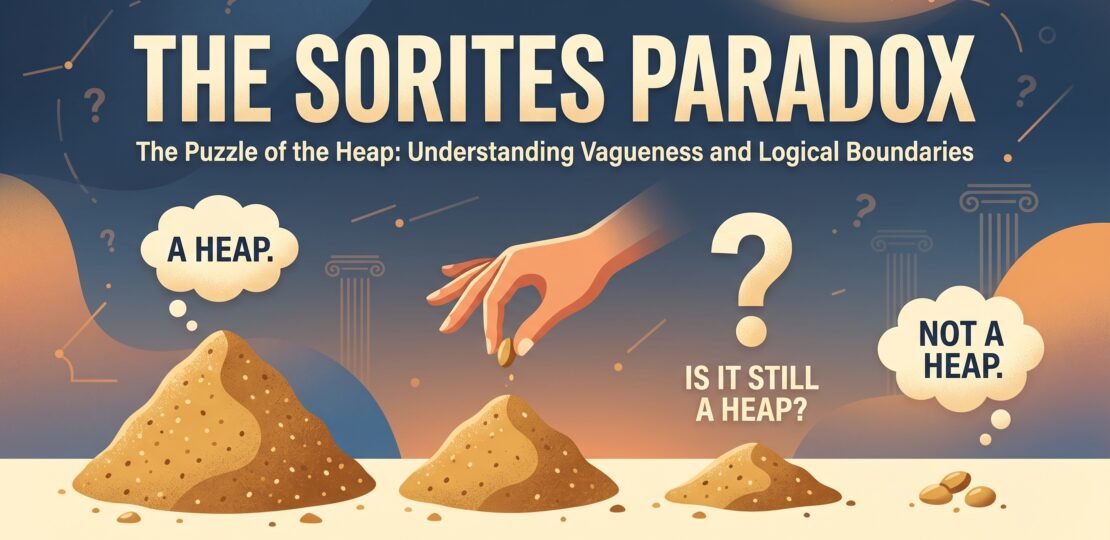
Imagine a pile of sand sitting on a beach.
Remove one grain. It is still a pile.
Remove another. Still a pile.
Keep removing grains one at a time. At no point does removing a single grain seem significant enough to transform the pile into something else. Yet eventually, there is only one grain left.
So when, exactly, did the pile stop being a pile?
This is the Sorites paradox, from the ancient Greek word sōros, meaning “heap.” It was first associated with the philosopher Eubulides of Miletus, who used it to expose a strange weakness in the way humans use categories.
The problem is not really about sand.
It is about the fact that many of our concepts have no precise boundary.
Consider the word tall. If someone is 6 feet tall, calling them tall seems reasonable. Remove an inch: still tall. Another inch: probably still tall. Continue the process and eventually reach someone who is clearly not tall.
But at which inch did they stop being tall?
There is no obvious answer.
The same problem appears everywhere. When does a forest become a collection of trees? When does a crowd become a crowd? When does a teenager become an adult? When does a language become a different language? How many changes can a person undergo before they
Human reasoning prefers clean categories. Something is either a chair or it is not. Someone is either rich or they are not. A collection is either
a crowd or it is not.
Reality is often less cooperative.
Many things change gradually, while language forces them into discrete boxes.
That creates a peculiar situation: the world may contain continuous transitions, but the mind wants boundaries.
The paradox becomes even more interesting when applied to identity.
A person changes constantly. Cells are replaced. Beliefs change. Memories fade. Personality evolves. Relationships alter priorities. Yet there is rarely a particular morning when someone wakes up and becomes a different person.
There is simply one small change after another.
Perhaps the lesson of the heap is not that categories are useless. Civilization could hardly function without them. Laws need definitions. Science needs classifications. Everyday communication depends on shared boundaries.
The lesson may simply be that some boundaries are made by us rather than discovered in nature.
A pile of sand does not contain a hidden line saying, “I ceased to be a pile here.”
We draw the line.
And perhaps we do this far more often than we realize.
RELATED POSTS
View all